
Factory visits in the pet industry are often treated as a relationship exercise: shake hands, see the production line, take photos, review a few samples, and leave with a better feeling about the supplier. That is useful, but it is no longer enough.
For overseas buyers, private-label brands, distributors, and sourcing teams, a pet factory tour should now be treated as a structured due diligence tool. The real value is not just seeing whether a factory is large or clean. The value is learning whether the supplier can turn samples into repeatable shipments, manage risk, document quality, and support the destination market after the order is placed.
A recent Chongyejia article on Sohu used three factory-visit routes around Qingdao, Weifang, and Linyi as a way to read China’s pet supply chain. The source article framed the routes around export-grade pet food capability, freeze-dried production scale, and full-chain integration. We are not treating the article as a buyer endorsement of any individual factory. The more useful lesson is broader: factory visits reveal information that supplier decks and certificates cannot.
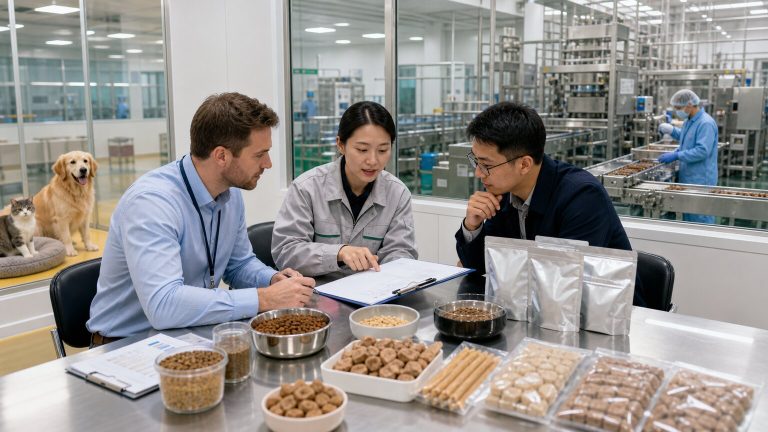
Why Factory Visits Matter More Now
The most expensive problem in supplier selection is not always price. It is information asymmetry.
A buyer sees a quotation, a website, a certification list, and a sample. The factory knows much more: which line will actually produce the order, how often raw materials change, whether records are organized, which operators are experienced, how deviations are handled, and whether the approved sample reflects normal production or a special preparation.
That gap becomes risky in pet categories because the product is emotionally sensitive and operationally complex. Pet food involves ingredient safety, nutrition, palatability, shelf life, process control, and labeling. Cat litter involves dust, absorption, odor control, breakage, packaging strength, and container loading. Pet supplies involve material safety, hardware durability, sizing, sewing, electronics in some cases, and retailer documentation. A factory visit helps the buyer see where the sales story meets the operating system.
This is why a useful tour is not a sightseeing route. It is an evidence-gathering process.
The Three Routes Are Really Three Supplier Questions
The Sohu source described three geographic routes in Shandong: Qingdao, Weifang, and Linyi. Each route can be translated into a buyer question.
Qingdao represents the export-standard question: can a supplier support demanding overseas markets with credible quality systems, export documentation, and category-specific production control?
Weifang represents the scale-and-specialization question: can a supplier in a concentrated freeze-dried pet food cluster manage capacity without losing consistency, safety discipline, or customization flexibility?
Linyi represents the integration question: can a supplier connect raw material sourcing, R&D, manufacturing, testing, packaging, and export service inside one coordinated system?
These questions are more useful than the place names. A buyer sourcing from China, Southeast Asia, Europe, Latin America, or the United States should ask the same three questions: what standard does the factory operate against, what product specialization does it truly control, and how much of the supply chain can it document?
What Buyers Should Look For Before The Tour Starts
A strong factory visit begins before anyone enters the gate. Buyers should prepare a product-specific agenda, not accept only the supplier’s standard showroom route.
For pet food, the agenda should include raw material receiving, storage, formulation control, production line flow, heat treatment or drying logic where relevant, packaging, retained samples, lab testing, pest control, batch records, complaint handling, and recall readiness. For freeze-dried products, the buyer should also ask about raw animal-source ingredient controls, validated safety steps, water activity, drying curves, tray loading, cross-contamination risk, and breakage rates.
For pet supplies, the agenda should match the category. A leash factory should be reviewed differently from a cat litter plant, a pet bed sewing facility, a grooming tool supplier, or a smart feeder assembly line. Product-specific risk matters more than a generic tour.
This connects with our earlier article on EU GPSR pet product compliance for buyers. Product safety is not one universal checklist. The relevant file, warning, test, material record, and traceability expectation depends on the product and the market.
Certificates Are Starting Points, Not Proof
The Sohu article listed many certifications and registrations for different factory examples. Those signals can be meaningful, especially when a supplier serves regulated export markets. But serious buyers should treat certificates as a starting point, not the final answer.
A certificate can show that a factory has passed a system review at a point in time. It does not automatically prove that a specific SKU, ingredient, production line, packaging material, label, or shipment is controlled in the way the buyer needs.
During a tour, buyers should ask how the certificate connects to daily operation. Who owns the system? How are records created? How are internal audits performed? What happens when a test fails? How are suppliers approved? How are production changes communicated to buyers? Are retained samples kept by batch? Are complaints linked back to production records?
The practical question is not “Do you have the certificate?” It is “Can you show how the system works on this product?”
FDA Rules Show Why Records Matter
For U.S.-bound pet food, the regulatory background reinforces this point. The FDA’s page on the FSMA preventive controls rule for animal food explains that covered animal food facilities must follow current good manufacturing practices and establish a food safety system that includes hazard analysis and, when needed, risk-based preventive controls.
That is a useful buyer lens even outside the United States. A strong factory should be able to explain hazards, controls, monitoring, corrective actions, verification, recall thinking, and supplier approval. The factory visit should test whether those ideas are visible in the plant, not just printed in a manual.
FEDIAF’s pet food safety guidance page makes a similar point from a European industry perspective. It describes safe pet food as a responsibility across the manufacturing process, from feed materials and additives to finished product, and frames good practice around safety and hygiene systems.
For global buyers, the message is consistent: quality is not only a finished product test. It is a managed process.
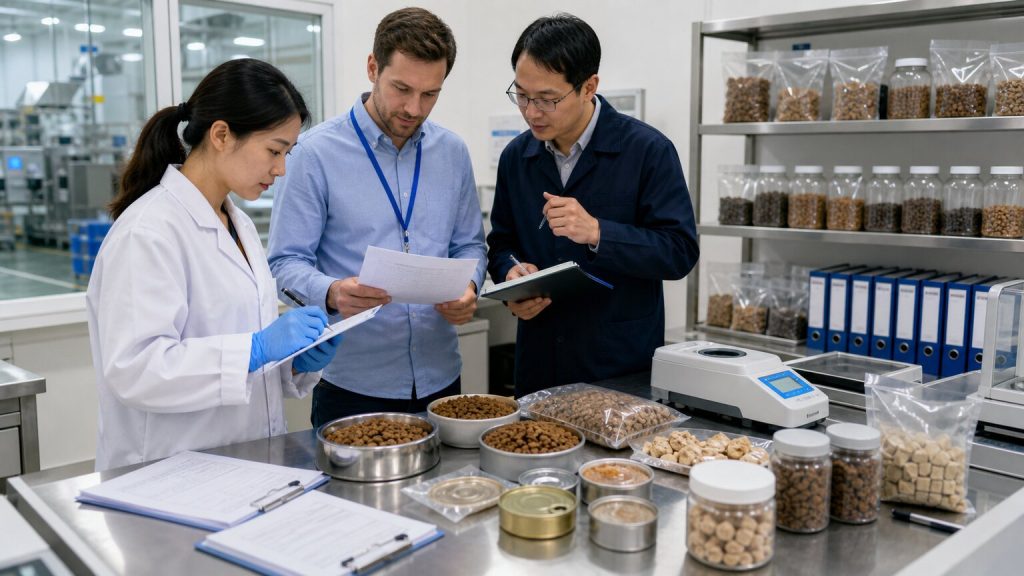
The Sample-To-Production Gap Is The Real Test
Many sourcing problems begin because the approved sample is not representative of normal production.
A factory may prepare a sample with extra care, better raw material, slower line speed, or a small pilot batch. The buyer approves it. Later, mass production uses a different raw material lot, a different operator team, different packaging film, different drying conditions, or a different line. The shipped product is technically similar, but the consumer experience changes.
This is why a factory visit should follow the sample backward and forward. Backward means asking where the sample came from: which line, which lot, which formulation version, which packaging, which test record. Forward means asking how that sample will become a purchase order: what parameters are locked, what tolerances are allowed, what changes require buyer approval, and what records will accompany production.
In our article on freeze-dried pet food customization, we made the same point from a category angle. Creative formats and small-batch flexibility are attractive, but they only become commercially useful when the supplier can repeat them safely and economically.
Factory tours should make that repeatability visible.
Export Quality Is More Than Export Documents
Export readiness is often described through documents: FDA registration, EU eligibility, third-party audit certificates, export declarations, and customer references. These matter. But export quality also lives in operational details.
A buyer should look at how materials are received and stored, whether packaging is protected from dust and moisture, whether allergens or species-specific materials are segregated, how metal detection or foreign-material controls are handled, how finished goods are released, and whether warehouse conditions match product needs.
For wet food, ask about retort or sterilization control, seal integrity, can or pouch defects, and incubation or release logic. For dry food, ask about extrusion or baking control, coating, moisture, and packaging barrier. For freeze-dried products, ask about raw material controls, microbial risk, water activity, oxygen exposure, and breakage. For treats and supplements, ask whether functional ingredients remain stable after processing and storage.
This links naturally to our analysis of functional pet food ingredients as an evidence test for buyers. A product claim is only as strong as the process that preserves the ingredient, dosage, and documentation behind it.
Why Production Clusters Matter
The Sohu article’s Weifang route highlights a point that overseas buyers should understand: production clusters can be powerful, but they can also create hidden assumptions.
A cluster can offer skilled labor, equipment suppliers, raw material access, packaging vendors, peer learning, and faster problem solving. It can also create intense price comparison, fast product imitation, and a tendency for suppliers to use similar language about capacity and capability.
When buyers evaluate a cluster, they should avoid treating every supplier in that area as interchangeable. Two factories may both say they make freeze-dried pet food, but one may be stronger in standard treats, another in full-meal formats, another in custom shapes, and another in export documentation. One may be better at high-volume efficiency while another is better at low-volume innovation.
The factory visit should reveal the supplier’s real lane. If a factory claims to do everything, ask which product type drives most of its revenue, which line has the strongest team, which format creates the most defects, and which orders it would rather not accept.
Full-Chain Integration Is Useful Only If It Is Controlled
The Linyi route in the source article points to full-chain integration: raw materials, formulation, production, quality testing, and finished product service under one larger system.
That can be valuable. A vertically integrated supplier may have better raw material visibility, faster issue resolution, more stable supply, and stronger cost control. For meat-based pet food, integration can be especially relevant because raw material freshness, species identity, cold-chain handling, and traceability can shape finished product reliability.
But integration is not automatically better. A fully integrated system can also hide internal assumptions. If the same group controls upstream supply and downstream production, the buyer still needs independent records, incoming material criteria, test results, release procedures, and change-control discipline.
In other words, the question is not whether the factory owns more of the chain. The question is whether it can prove control across the chain.
This is close to the lesson in our article on pet food lighthouse factory quality and traceability. Advanced manufacturing becomes commercially meaningful when it produces better traceability, consistency, and decision visibility, not just impressive equipment.
How To Read The Warehouse And Packing Area
Many buyers spend too much time in the sample room and too little time in the warehouse.
The packing and finished-goods area often reveals how a factory thinks. Are cartons organized by batch and customer? Are labels controlled? Are mixed-SKU shipments separated clearly? Are pallets protected from moisture? Are retained samples linked to shipment lots? Are damaged cartons isolated? Are export cartons matched to real handling conditions?
For pet supplies, packaging can decide whether a product survives ecommerce, retail distribution, or container loading. For pet food, packaging affects shelf life, oxygen exposure, moisture protection, odor transfer, and consumer trust. For cat litter, packaging strength, pallet stability, dust control, and weight accuracy can directly affect claims and returns.
This is why our previous article on cat litter category sourcing strategy emphasized material performance and logistics, not only formula or price. Heavy, dusty, absorbent products can look simple until they move through real distribution.
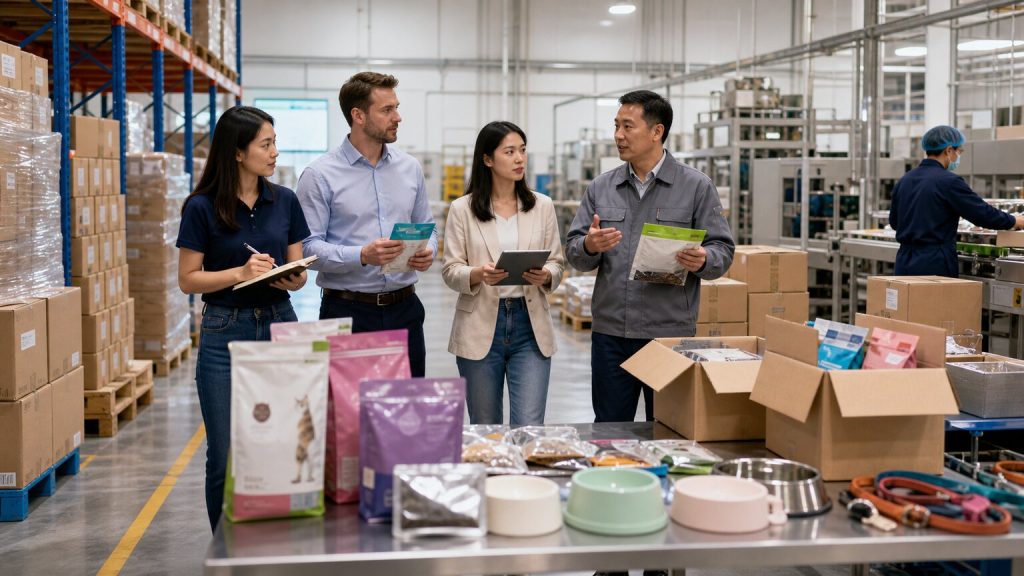
What Buyers Should Ask During A Pet Factory Tour
A buyer does not need to turn every visit into a formal audit. But the questions should be sharper than a normal sales meeting.
Ask what the factory does best and what it does not want to produce. Strong suppliers usually know their limits. Ask which line will make your product, not only which line looks best during the tour. Ask how the approved sample will be locked into production. Ask which raw materials are buyer-approved and which may be substituted. Ask what documents the factory can provide before shipment, not after a problem.
Ask to see one recent batch record with sensitive customer information hidden. Ask how complaints are investigated. Ask how a product is released from QA hold. Ask what happens when a supplier changes a raw material. Ask how many production lots are represented in a finished shipment. Ask how the factory keeps old labels, new labels, and market-specific versions separate.
The answers matter, but the response behavior also matters. A capable factory may not show every confidential record, but it should understand the question and explain its system clearly. A weaker supplier may answer with slogans, certificates, or price language because it cannot connect the question to operating records.
What Factories Can Do Better
Factory tours are not only for buyers. They are also a chance for suppliers to communicate capability more effectively.
A supplier that wants serious international accounts should prepare a buyer-facing audit path. That path should show raw material control, product development, line capability, QA testing, retained samples, packaging control, warehouse flow, export documentation, and after-sales issue handling. It should not rely only on a showroom wall of certificates.
Factories should also prepare category-specific evidence. A freeze-dried supplier should be ready to explain moisture, water activity, microbial control, breakage, and packaging. A wet food supplier should be ready to explain thermal processing, seal checks, shelf-life logic, and release records. A pet supplies factory should be ready to explain material safety, hardware testing, sewing strength, electronics documentation where relevant, and packaging durability.
The best suppliers make operating discipline visible without turning the visit into theater.
Our View
The factory visit is becoming more important because the pet supply chain is becoming more specialized. Buyers do not only need access to production. They need confidence that the supplier can support the product’s risk profile, destination market, channel requirements, and repeat orders.
For overseas buyers, the next pet factory tour should be planned like due diligence. Do not only ask whether the factory can make the product. Ask whether it can prove how the product is controlled.
For suppliers, this is an opportunity. Many factories can show machines. Fewer can explain records, change control, food safety logic, packaging release, and customer-specific production discipline. The factories that can make those systems visible will be easier for global buyers to trust.
For more pet industry sourcing, manufacturing, compliance, and product-development analysis, readers can also follow Pet Industry Insights on Facebook.
References
Chongyejia on Sohu: three pet factory visit routes around China’s pet supply chain
FDA: FSMA final rule for preventive controls for animal food