
Freeze-dried pet food is no longer only a premium-looking product format. For private-label brands, distributors, and overseas buyers, it is becoming a practical test of whether a supplier can combine formulation work, small-batch flexibility, process control, food safety discipline, and export documentation in one operating system.
That is the useful signal behind a recent Sohu factory-visit report on Yahua Pet Food and its Yupai-related freeze-dried production layout in Weifang, China. The source report describes a dual-factory freeze-dried pet food system, source-reported annual capacity of about 4,000 tons, more than 500 brand customers served, more than 1,200 mature formulas, more than 300 mold types, and more than 400 new products developed annually.
Those figures should be treated as company-visit claims, not as universal market benchmarks. But they are still useful for overseas buyers because they show what a serious freeze-dried supplier now wants to prove: not only production capacity, but also the ability to turn custom ideas into repeatable, auditable products.
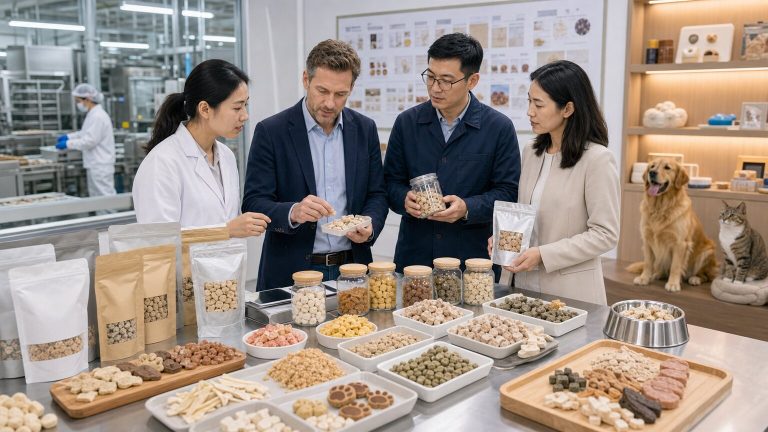
Why Freeze-Dried Customization Is Hard
Freeze-dried products look simple from the shelf. A consumer sees meat cubes, shaped snacks, toppers, full-meal pieces, coated kibbles, or functional treats. Behind the product, however, the manufacturer is managing a difficult balance.
The buyer wants differentiation. The brand team wants a shape, ingredient story, texture, nutrition angle, and package that competitors do not already sell. The operations team wants reasonable minimum order quantities, stable yield, predictable cost, and repeatable production. The quality team wants moisture control, microbiological safety, traceability, label discipline, and shelf-life confidence.
Those goals often conflict. A creative shape may require a mold, more manual handling, and higher breakage risk. A high-meat formula may be harder to form, dry, package, and protect from oxidation. A functional ingredient may create claim risk if the evidence, dosage, and label language are not aligned. A low-MOQ trial may be commercially useful for a new brand, but inefficient for a production line built around larger batch runs.
This is why freeze-dried customization is becoming a supplier capability test. It asks whether a factory can manage creativity, repeatability, and cost at the same time.
The Shift From Standard SKUs To Custom Product Systems
Standard freeze-dried treats are now easy to find. That does not mean they are easy to make well, but the category has become crowded. Basic chicken, duck, beef, fish, or mixed-protein cubes can quickly move into price competition, especially when ecommerce platforms make comparison easier.
The more strategic opportunity is in custom systems: brand-specific shapes, multi-ingredient pieces, toppers designed for dry food, freeze-dried inclusions for wet or baked formats, functional treats, senior pet nutrition concepts, and private-label lines that need a clear reason to exist.
The Sohu report says Yahua entered the pet sector in 2019 and gained attention with creative freeze-dried products such as a cat-paw-shaped snack. The important point is not the individual shape. The important point is the operating lesson: in a crowded premium format, visual differentiation and formula flexibility can become part of the supplier’s value proposition.
For buyers, that means a supplier should not be evaluated only by a product catalog. The better questions are: how fast can the supplier move from brief to sample? How many iterations are normal? How does it calculate yield loss? Who owns the mold? What happens if a custom shape breaks during transport? Can the same product be produced consistently after the first order?
R&D Has To Include Product, Process, And Equipment
The source article frames the factory’s capability around a three-part R&D system: equipment engineering, process R&D, and product R&D. That structure is worth adopting as a buyer lens even when evaluating other suppliers.
Product R&D is what buyers usually see first. It covers formula, ingredient selection, palatability, product role, shape, nutritional positioning, and packaging concept. This is where a brand brief becomes a sample.
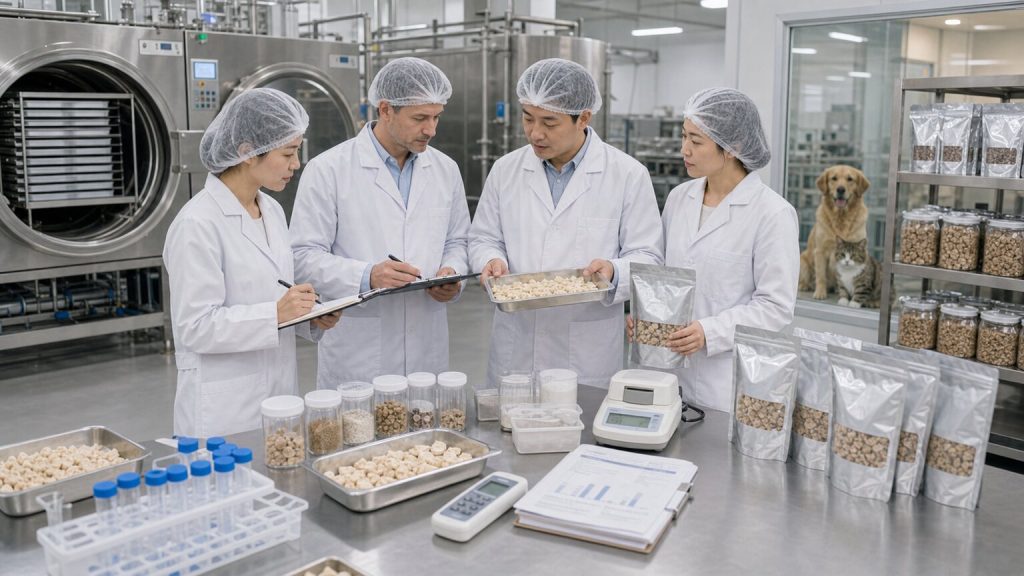
Process R&D is the less visible but often more important layer. Freeze-dried products depend on pre-treatment, cutting or forming, loading, freezing behavior, drying curve, moisture target, water activity, packaging seal, oxygen exposure, and post-production handling. A supplier that only shows attractive samples but cannot explain the process controls is not ready for serious export programs.
Equipment engineering matters because freeze-drying is capital-intensive. Chamber capacity, tray design, temperature control, vacuum performance, cleaning workflow, energy use, and line layout all influence cost and repeatability. A factory with multiple chambers may have more scheduling flexibility, but buyers still need to know which products can run together, how allergen or species segregation is handled, and how validated settings are protected from casual changes.
This connects with our earlier analysis of pet food factory quality and traceability. A good pet food factory is not simply a place with modern machines. It is a system of records, controls, and accountability.
Small-Batch Flexibility Is Valuable, But It Has A Real Cost
The Sohu report says some creative freeze-dried projects can begin with minimum order quantities of only a few hundred kilograms. If a factory can really support that while maintaining quality, it is valuable for overseas brands testing a niche format or local distributor launching a market-specific product.
But low MOQ should not be treated as free flexibility. Small-batch freeze-dried projects can involve mold work, formulation trials, higher labor intensity, higher loss rates, separate packaging setup, and more quality checks per unit of output. If the buyer pushes too hard for both novelty and low cost, the supplier may quietly simplify the formula, increase tolerances, reduce documentation, or turn the product into a catalog item with a cosmetic change.
A good supplier should be able to explain the economics clearly. It should separate sample-stage costs from commercial-stage pricing. It should define what counts as a formula change, what counts as packaging customization, what is included in mold fees, and when a product becomes eligible for lower pricing.
For private-label buyers, this is a major negotiation point. The cheapest quote may not be the best one if it hides development costs, quality risk, or future supply instability.
Food Safety Cannot Be Assumed From The Word "Freeze-Dried"
One common mistake is treating freeze-drying as if it automatically makes a raw animal-source product safe. Freeze-drying removes water under controlled conditions, but it is not the same as cooking. If a product starts with raw animal ingredients, the supplier still needs a serious food safety plan.
The U.S. FDA’s general pet food guidance emphasizes that pet food must be safe, properly manufactured, and properly labeled. FDA also warns consumers and industry participants about risks associated with raw pet food diets, including pathogen concerns. That point matters because a freeze-dried product can still need a validated safety plan if the inputs or processing route carry raw animal-source risk.
For buyers, this does not mean freeze-dried products should be avoided. It means supplier evaluation must be specific. Ask whether there is a validated kill step. Ask what pathogen testing is performed. Ask how water activity is controlled. Ask how high-risk ingredients are segregated. Ask how retained samples are stored. Ask how deviations are handled. Ask whether the supplier can provide batch-level documentation, not just a factory certificate.
The stronger the product’s raw-meat story, the more disciplined the safety evidence needs to be.
Functional Freeze-Dried Products Need Evidence Discipline
Freeze-dried pet food is also moving into functional territory. Brands are exploring probiotics, peptides, joint-support ingredients, skin and coat positioning, gut-health concepts, urinary-support ideas, senior-pet products, and supplement-like formats.
This can be commercially attractive, but it raises the bar for evidence and label review. A functionally positioned freeze-dried product is not just a snack with a premium ingredient. The buyer needs to know ingredient dosage, stability after processing, shelf-life behavior, target species, feeding directions, claim boundaries, and market-specific regulatory expectations.
AAFCO’s consumer guide to reading pet food labels is a useful reminder that product names, ingredient lists, nutritional adequacy statements, feeding directions, and label language all carry meaning. In export markets, the wrong claim can create more risk than the formula itself.
This is where private-label teams should be cautious. A supplier may be strong at creative samples but weak at evidence files. Another supplier may have good scientific support but weaker commercial packaging. The best partner is the one that can connect formulation, processing, documentation, and claim discipline.
That logic also applies to adjacent nutrition categories. Our article on senior cat food as a growth lane made the same point: functional positioning works only when the product story is backed by formula logic and responsible labeling.
Export Readiness Is More Than A Certificate List
The Sohu report says the company has certifications and registrations including ISO 22000, ISO 9001, HACCP, BRCGS, IFS, BSCI, and FDA registration, and that it has served export markets including Southeast Asia while expanding toward Europe and the United States. Those are useful signals, but buyers should not stop there.
Certificates are factory-level indicators. A buyer still needs SKU-level and order-level readiness. Can the supplier support the destination market’s ingredient rules? Can it prepare the correct label information? Can it provide a specification sheet, test report, ingredient origin record, shelf-life study, packaging specification, and production batch record? Can it handle retailer audit questions? Can it explain what has changed between the development sample and the mass-production batch?
For overseas buyers, this is where a freeze-dried supplier becomes either a long-term partner or a one-time sample vendor.
The same evaluation logic applies across pet food manufacturing. In our analysis of meat processors entering pet food manufacturing, the core issue was not scale alone. It was whether upstream strength could be converted into pet-specific quality, labeling, and traceability.
Buyer Questions For A Freeze-Dried Supplier
A serious buyer brief should make the supplier prove both creativity and control.
Start with product role. Is the item a treat, topper, supplement, complete food, inclusion, or bundle component? The answer affects nutrition expectations, feeding directions, packaging, and claim risk.
Then ask about raw materials. What species and cuts are used? Are ingredients fresh, frozen, cooked, raw, or pre-treated? How are suppliers approved? How close is the raw material source? What documents are available for each batch?
Move to process. What is the freeze-drying curve? What moisture and water-activity targets are used? Is there a validated pathogen-control step? How are molds cleaned? How are manual operations controlled? What are normal breakage, shrinkage, and loss rates?
Ask about commercialization. What is the real MOQ for a custom formula? What is the MOQ for custom packaging only? Who owns the mold? What happens if the first commercial batch differs from the approval sample? How long does a new product normally take from brief to shipment?
Finally, ask about export support. Which markets has the supplier shipped to? What documents can be provided before payment? Which claims will the supplier refuse to print? How are complaints, recalls, and retained samples handled?
These questions are direct, but they are not unreasonable. Freeze-dried products can carry premium pricing only if the supplier can support premium-level confidence.
What This Means For Brands And Distributors
For overseas distributors, freeze-dried products can create a strong premium lane because they are visible, tactile, and easy to merchandise. For ecommerce brands, they can support sampling, bundles, toppers, and higher-margin repeat purchases. For private-label retailers, they can help differentiate a pet food line without building a full manufacturing platform.
But the category is not automatically easy. It requires cold-chain or raw-material discipline before production, precise dehydration control during production, careful packaging after production, and responsible communication in the market. The more customized the product, the more important supplier systems become.
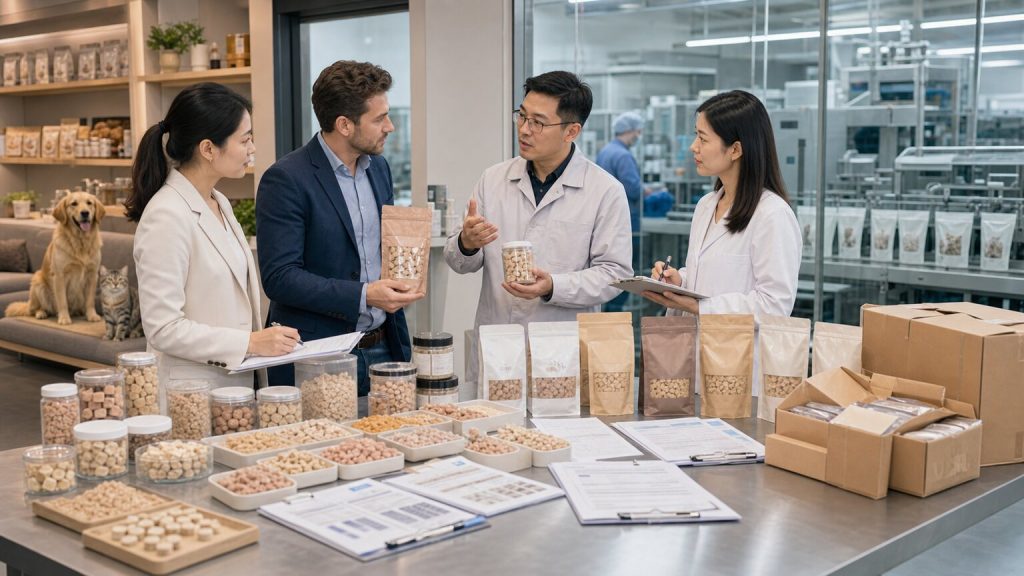
This is why buyers should evaluate freeze-dried suppliers as product-development partners, not only as factories. A supplier with a deep mold library, flexible formulation team, process records, safety testing, and export documentation may justify a higher price than a factory offering only basic cubes at the lowest quote.
The commercial opportunity is real. The sourcing risk is also real. Freeze-dried pet food is attractive precisely because it sits at the intersection of premium product storytelling, technical manufacturing, and buyer trust.
The Bigger Industry Signal
The freeze-dried category shows where pet food sourcing is heading. Brands want differentiation, but they also want speed. Buyers want innovation, but they also want documentation. Factories want higher-value products, but they also need production efficiency. Consumers want visible quality cues, but regulators and retailers still care about safety and truthful labeling.
That mix favors suppliers that can operate across disciplines. The next generation of freeze-dried pet food partners will not win only by having large chambers or a long sample table. They will win by combining R&D, process engineering, QA, export support, and commercial honesty.
For overseas buyers, the sourcing question is therefore simple: can the supplier turn a creative brief into a product that is safe, repeatable, documented, and commercially realistic?
If the answer is yes, freeze-dried customization can be more than a premium trend. It can become a durable private-label and distribution opportunity.