
When a large meat-processing company enters pet food, the story is not only about one more brand joining a crowded category. It is a signal that pet food competition is moving deeper into upstream supply chains: protein sourcing, by-product utilization, ingredient cost control, production scale, traceability, and the ability to serve private-label customers with consistent quality.
That is the broader significance of a new project reported by Sohu. A Sohu pet-industry article said that Linyi’s administrative approval bureau recently published approval information for a project named “Chong Ai Jia annual 200,000-ton pet food project.” The report links the project to the Jinluo business ecosystem, says it is located in Jinluo Science and Technology Park in Lanshan District, Linyi, and cites planned investment of roughly RMB 546 million to RMB 660 million, with pet food capacity, soybean dietary fiber activity, land, and construction scale all part of the project discussion.
For overseas buyers, distributors, and private-label brands, the useful question is not whether this specific project becomes a famous pet food brand. The more important question is why a meat-processing giant would enter pet food manufacturing at all, and what that means for the next phase of pet food supply.
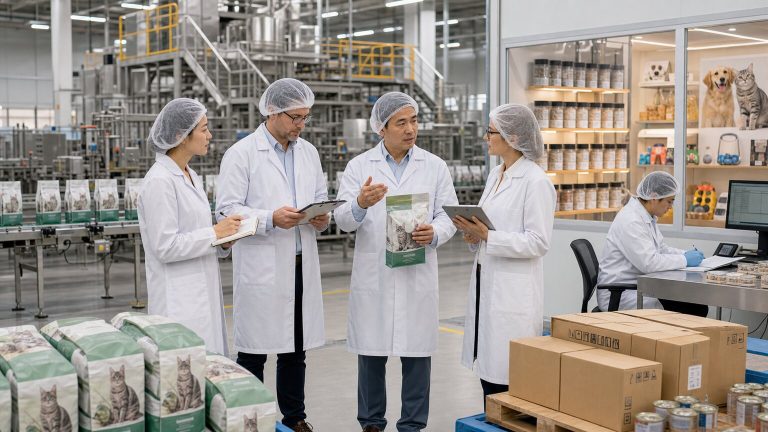
Pet Food Is Becoming A Supply Chain Game
Pet food used to be discussed mainly through brand, formula, flavor, packaging, and channel. Those still matter. But as the market matures, the harder questions sit behind the package.
Who controls the protein stream? Who has access to stable animal-derived ingredients? Who can manage raw material volatility? Who can process ingredients consistently? Who can scale without losing quality? Who can support export documentation, private-label customization, and retailer audits? Who can price competitively when ecommerce platforms and retail channels keep pushing margin pressure back onto manufacturers?
Those are supply-chain questions. Meat processors are built around many of the same capabilities: procurement, slaughtering or processing, cold-chain discipline, food safety systems, by-product utilization, scale production, and cost management. If a meat company already handles animal protein at industrial scale, pet food becomes a logical extension – not a simple side project, but a way to move further along the value chain.
A China Daily Linyi profile of Jinluo Group describes Jinluo as headquartered in Linyi and founded in 1990, with business sectors including pig slaughtering, processed meat products, soy deep processing, agriculture and animal husbandry, and medical health. The same profile says the group has 11 production bases, annual capacity to slaughter 20 million pigs and 200 million chickens, produce 2 million metric tons of meat and meat products, and process 500,000 tons of soybeans.
Those numbers are not pet food capacity by themselves. But they explain why pet food is strategically attractive to this type of company.
Protein Access Is A Competitive Advantage
Protein is one of the most important cost and quality variables in pet food. It shapes nutrition, palatability, product positioning, price, and consumer trust. It also creates volatility because animal protein supply is affected by livestock cycles, food demand, processing yield, export demand, disease risk, regulation, and logistics.
A meat processor may have advantages that many pure pet food startups do not. It may understand meat procurement, have relationships with farms and processing plants, control certain ingredient streams, know how to manage cold-chain and storage, and already operate food safety systems. It may also be able to use certain by-products or co-products more efficiently, turning material that is less valuable in human food channels into higher-value pet food ingredients.
This does not automatically make the company a better pet food manufacturer. Pet food has its own formulation, nutritional adequacy, palatability, extrusion, drying, baking, retorting, packaging, labeling, and channel requirements. But upstream protein access can still be a meaningful advantage if the company builds the right pet food team around it.
For buyers, the question is practical: does the supplier simply have access to raw materials, or can it translate that access into consistent pet food quality? The difference matters. A strong ingredient position helps only if it is paired with formulation discipline, process control, batch records, contamination management, and transparent documentation.
Soy And Fiber Create Another Layer
The Sohu report also mentions a 5,000-ton soybean dietary fiber project in the same broader project context. That detail is worth noticing because Jinluo is not only a meat processor. The China Daily Linyi profile says Jinluo also operates soy deep-processing and processes 500,000 tons of soybeans annually.
Pet food buyers often focus on animal protein, but plant-derived ingredients are also important. Soy protein, fiber, starch, pea products, rice, wheat, corn, and other plant ingredients can affect texture, cost, stool quality, kibble structure, moisture behavior, extrusion performance, and nutritional balance.
Soy ingredients are not automatically good or bad. Their value depends on processing quality, digestibility, anti-nutritional factor control, product format, species, claim language, and consumer perception in the target market. In some markets, soy can support cost and functionality. In other markets, consumers may prefer grain-free, limited-ingredient, high-meat, or novel-protein positioning.
That makes integrated meat and soy capability interesting. A supplier with both animal protein and soy-processing experience may be able to design products across multiple price bands: mainstream kibble, baked food, treats, semi-moist formats, functional snacks, and private-label products requiring a specific balance of palatability and cost.
But again, capability has to be proven. A buyer should ask how soy or fiber ingredients are specified, tested, labeled, and positioned. In pet food, ingredient advantage is only useful when the finished product fits the market story and regulatory environment.

Large Capacity Can Help Private Label, But It Can Also Create Pressure
A 200,000-ton pet food project, if built and operated as described by the source report, would be a major capacity signal. For private-label buyers and distributors, large capacity can be attractive. It may support better pricing, consistent supply, multiple formats, stronger production scheduling, and more confidence during peak seasons.
Capacity alone, however, is not enough. Large factories need demand. If capacity enters the market faster than brand demand, competition can become more aggressive. Suppliers may chase volume, lower margins, and accept more private-label projects. That can benefit buyers in the short term, but it can also create risks if factories cut corners, overpromise customization, or treat pet food as a commodity.
The better model is not simply “bigger factory, cheaper product.” It is “larger factory with disciplined product architecture.” A strong large-scale supplier should be able to separate mainstream volume SKUs from premium formulations, functional products, treats, export SKUs, and channel-specific packaging.
This is where our earlier article on pet supply-chain conferences and 2026 category demand is relevant. The next phase of pet product demand is not only about size. It is about matching channel data, cost engineering, packaging, compliance, and repeatable manufacturing.
Food Safety Experience Does Not Replace Pet Food Expertise
Meat processors often bring strong food safety culture. That matters. But pet food is not human meat processing with a different label.
Pet food needs species-appropriate nutrition, product-format knowledge, palatability work, stability testing, packaging decisions, and label review. Kibble extrusion is different from processed meat. Wet food retort control is different from sausage processing. Treats, chews, freeze-dried products, baked products, and semi-moist formats each have different technical and safety questions.
The U.S. FDA’s pet food information makes the baseline point: pet food must be safe, produced properly, labeled properly, and not misleading. AAFCO’s guide to reading pet food labels also shows how product name, ingredient list, nutritional adequacy statement, feeding directions, and other label elements define the product.
For a meat processor entering pet food, these rules create a learning curve. It may already know food factories, but it still needs pet nutritionists, pet food process engineers, regulatory reviewers, palatability testing, and people who understand pet retail channels.
The Sohu report notes that the related company has been recruiting ecommerce and pet food R&D talent, including formulation roles for extruded and baked pet food. That is the right direction. Cross-category entry works better when the parent company brings supply-chain strength and then hires category-specific expertise.
What Overseas Buyers Should Watch
For overseas buyers, the entry of meat processors into pet food creates both opportunity and caution.
The opportunity is obvious. These companies may offer raw material depth, large capacity, cost stability, stronger procurement systems, and food-grade process discipline. They may become useful OEM, ODM, or private-label partners, especially for mainstream dry food, treats, meat-based snacks, baked products, and products where protein sourcing is central to the brief.
The caution is equally important. A company new to pet food may not yet understand export market claims, nutritional adequacy statements, life-stage positioning, brand storytelling, ecommerce content, retailer audit expectations, or the difference between “food company” credibility and “pet food” credibility.
Buyers should ask specific questions:
What pet food formats are actually running at commercial scale? Which products are pilot-stage only? Who owns formulation? What nutritional standards are used? Are there pet food-specific quality records? Can the supplier provide batch traceability from raw materials to finished product? What tests are done on finished food? How are label claims reviewed? What export markets has the factory already served? What is the minimum order quantity for real customization, not just package changes?
These questions are not meant to disqualify new entrants. They are meant to separate supply-chain strength from category readiness.
The Private-Label Angle
Large meat processors may become important to private-label pet food because they can combine ingredient access with manufacturing scale. That is attractive to retailers, distributors, and ecommerce operators that want stronger control over cost and supply.
Private label is no longer only a low-price strategy. In pet food, private label can also target premium wet food, functional treats, high-protein kibble, senior nutrition, small-pet products, club-store multipacks, and subscription formats. The buyer needs suppliers that can deliver not only capacity but also formulation support, packaging engineering, label review, and repeatable documentation.
This connects naturally to our analysis of senior cat food as a growth lane for pet brands. Senior pet nutrition is a good example of a category where a private-label buyer cannot rely on low cost alone. The formula, texture, claim language, and trust signals all matter.
For a meat processor, the best position may not be to compete only on price. It may be to become a supplier that can support multiple private-label tiers: value, mainstream, premium, and functional. That requires more than raw material supply. It requires pet food product management.
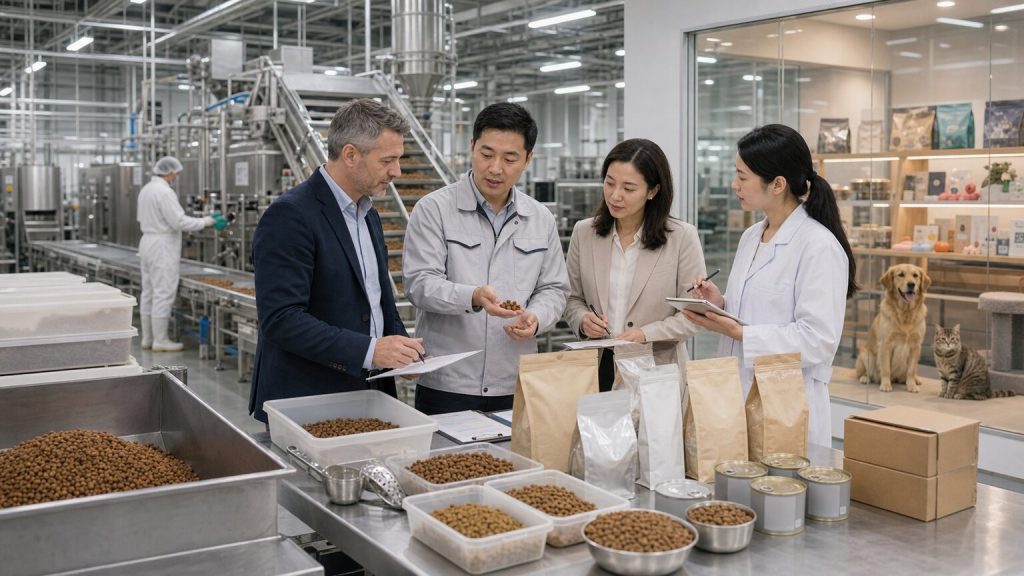
Export Buyers Need Traceability, Not Just Scale
Scale can attract overseas buyers, but traceability keeps the relationship alive.
A large integrated supplier should be able to show where materials come from, how they are approved, how batches are recorded, how deviations are handled, how retained samples are managed, and how finished goods are linked to production records. If the supplier is using animal-derived ingredients, buyers may also need documentation related to species, origin, processing, storage, transport, and market-specific restrictions.
For export buyers, documentation can be as important as price. A product that cannot clear a retailer audit, platform review, customs requirement, or complaint investigation is not cheap in the long run. That is why our article on pet food factory quality and traceability focused on systems and records rather than scale alone.
Large food companies may have an advantage here if they already operate mature quality systems. But buyers should verify the pet food implementation, not assume it from the parent company’s human food business.
What This Means For Smaller Pet Food Suppliers
If more large meat and food companies enter pet food, smaller pet food suppliers may face pressure in mainstream formats. Large entrants can push down prices, increase available capacity, and make it harder for undifferentiated factories to compete.
That does not mean smaller suppliers lose automatically. Smaller pet food companies can still win through specialization: novel proteins, freeze-dried formats, veterinary-adjacent products, small-batch premium food, functional treats, fast customization, export documentation expertise, or deep category knowledge.
The real risk is being stuck in the middle. A small factory that cannot beat large players on cost and cannot beat specialists on innovation will have a weak position. Buyers will increasingly ask suppliers to prove why they are the right partner for a specific product lane.
Large meat processors entering pet food may therefore sharpen the market. They can take some mainstream volume. Specialists can own technical or premium niches. Brands and buyers will have more options, but they will need better supplier evaluation.
The Bigger Industry Signal
The Jinluo-linked project reported by Sohu is best read as part of a wider pattern: pet food is becoming attractive to companies that already control adjacent food, protein, agriculture, retail, or consumer-goods infrastructure.
Some entrants will try to build brands. Others will supply private label. Some will use pet food to absorb ingredient streams and improve margins. Others will pursue export manufacturing or domestic channel expansion. The strategic logic differs, but the direction is similar: pet food is no longer isolated from the broader food industry.
For overseas buyers, that creates a more complex sourcing landscape. A traditional pet food specialist may offer category experience. A meat processor may offer ingredient scale. A consumer goods company may offer channel discipline. A lifestyle brand may offer community access. The right choice depends on product role, channel, price band, claim risk, and documentation needs.
The entry of meat processors into pet food should not be treated as automatic disruption. It should be treated as a capacity and supply-chain signal. The companies that succeed will be those that combine upstream protein advantage with pet-specific formulation, quality systems, transparent labeling, and channel understanding.
That combination, not scale alone, is what overseas buyers should watch.