
Senior cat food is moving from a niche shelf label to a serious category strategy. The signal is not only that older cats need different feeding decisions. The signal is that pet owners, ecommerce platforms, brands, and suppliers are beginning to organize products around life stage, health sensitivity, texture, hydration, and repeat care.
A recent Sohu pet-industry article reported several notable 2026 Tmall 618 data points: senior cat complete wet food sales increased by more than 300% year over year, senior cat prescription food grew by nearly 80%, and senior cat and dog nutrition paste sales rose by more than 260%. The same article argued that the first visible breakout was senior cat complete wet food, but that the larger shift is toward lifecycle-based pet care.
For overseas pet food brands, private-label teams, distributors, and sourcing managers, this is worth more than a quick trend note. Senior cat nutrition sits at the intersection of aging pets, premium wet food, functional positioning, veterinary sensitivity, packaging engineering, and compliance risk. That makes it commercially attractive, but it also makes the category harder to execute than ordinary flavor expansion.

The Market Is Moving From Age Labels To Lifecycle Strategy
Pet food has always used life-stage language. Kitten, adult, senior, indoor, hairball, weight control, sensitive stomach, urinary, and sterilized are familiar shelf terms. What is changing is the depth of the strategy behind those labels.
In many markets, the older pet population is expanding because a large group of pets adopted during earlier pet-ownership growth waves is now aging. The Sohu article cites Chinese industry figures suggesting that cats and dogs aged seven and above are becoming a larger share of the pet population, and that more than 30 million dogs and cats in China have entered what the article calls a senior stage. Treat those figures as source-reported market signals, not universal global statistics. The broader commercial direction is still clear: more households are planning for the later years of pet ownership.
That creates a different purchase mindset. A younger cat may be marketed around growth, coat condition, activity, flavor variety, or convenience. A senior cat creates different concerns: appetite, hydration, chewing comfort, weight maintenance, digestion, urinary and kidney sensitivity, joint comfort, and the owner’s fear of decline.
The language also changes. Instead of “my cat likes this flavor,” the owner may ask whether the food is easier to eat, whether it helps the cat drink more water, whether the protein and mineral profile is appropriate, whether the texture works for weaker teeth, and whether the label is trustworthy. That is a more demanding consumer.
Why Wet Food Leads The Conversation
Wet food has several attributes that fit senior cat positioning. It is moisture-rich, easier to chew than many dry foods, usually more aromatic, and easier to portion into smaller meals. Those attributes matter because older cats may eat less, drink less, lose body condition, or become more selective.
That does not mean wet food is automatically a medical solution. Brands should avoid treating moisture, texture, or palatability as a shortcut to therapeutic claims. A senior cat wet food can be a complete daily diet, a complementary food, a topper, or a veterinary diet depending on its formulation, evidence, and label. Those categories must not be blurred.
This is where the opportunity becomes more serious. Senior cat wet food is not just “cat food in a can.” It requires a product architecture. The brand has to decide whether the product is complete and balanced for senior maintenance, a general adult product with senior-friendly texture, a targeted veterinary diet, a hydration-support topper, or a high-palability recovery-style format that should be used under veterinary guidance.
AAFCO’s guidance on reading pet food labels is useful here because it explains how product names, ingredient lists, nutritional adequacy statements, feeding directions, and other label elements help define what the product actually is. For B2B buyers, that label discipline matters as much as the formula.
The First Buyer Question: Complete Food Or Support Product?
The most important question for any senior cat product brief is simple: what role does this product play in the feeding routine?
If it is a complete wet food, the nutritional adequacy position needs to be clear. The buyer should understand the target life stage, the nutrient profile, the feeding direction, the calorie density, the protein and fat logic, and the mineral approach. If it is a complementary product, topper, mousse, broth, puree, or paste, the packaging and sales team should not imply that it can replace a complete diet.
This distinction is not only regulatory. It changes channel fit and repeat economics. Complete wet food supports a recurring meal plan. Toppers and hydration products may support add-on baskets. Nutritional pastes and supplements may support higher margin but require more careful claim language. Veterinary diets may create trust and premium pricing, but they also require stronger documentation, professional channel strategy, and clearer consumer education.
The Sohu article suggests that senior pet supplements could become the next major growth lane after senior cat complete wet food. That is plausible, but it increases the evidence burden. Joint, kidney, heart, cognitive, digestive, and immune-support language can quickly move from lifestyle positioning into health claim territory. Suppliers and brands need to know where that line sits in each target market.
The U.S. FDA’s guidance on animal food labeling and pet food claims is a useful reminder that claims should not mislead consumers. A product can have a strong market story, but the label, evidence, and formulation must be able to carry it.
Product Development Needs More Than A Senior Sticker
For private-label and export suppliers, the tempting mistake is to create a senior SKU by adjusting the package design and adding a softer claim set. That is not enough.
A credible senior cat wet food program needs decisions on texture, moisture, aroma, digestibility, calorie density, protein source, mineral profile, palatability, portion size, can or tray format, shelf life, sterilization parameters, and complaint handling. The product also needs to fit the retailer’s channel. A premium pet specialty store may want detailed formulation language. A marketplace listing may need clearer comparison images and feeding guidance. A club store may need multipacks and strong outer-carton protection. A veterinary channel may need professional recommendation logic.
Texture is especially important. Senior cats may prefer pate, mousse, minced meat, gravy, jelly, or smaller shredded formats depending on dental condition and habit. This is not purely a sensory choice. Texture affects processing, filling, sterilization, separation risk, appearance after opening, and whether the product still looks acceptable after transport and storage.
Packaging is also more complex than it first appears. Cans communicate durability and shelf stability. Trays can support portion control and premium appearance. Pouches can be convenient but may raise questions around fill consistency, shelf display, and damage. Multipacks can raise average order value but increase carton and ecommerce shipping requirements.
This connects with our recent article on pet supply-chain conferences and 2026 category demand. Senior pet nutrition is exactly the type of category where product insight, cost engineering, packaging, testing, and channel data need to work together.

Manufacturing Capability Becomes A Filter
Senior cat wet food looks like a market opportunity, but buyers should treat supplier capability as a filter before they chase the category.
For canned and tray-based wet food, the buyer needs confidence in thermal processing, seal integrity, fill weight control, texture stability, batch traceability, shelf-life validation, contaminant control, and finished-product testing. A supplier that makes standard wet food may still need additional development work to support senior-specific texture, lower mineral positioning, higher palatability, or smaller portion formats.
The FDA’s general pet food information page is a useful baseline: pet food must be safe, produced properly, labeled properly, and not misleading. In practical sourcing terms, buyers should translate that into concrete supplier questions. How are batches tracked? How are incoming ingredients approved? How is seal failure monitored? How is shelf life validated? How are customer complaints investigated? How are formulation changes documented?
This is also where our article on pet food lighthouse factory quality and traceability becomes relevant. Senior nutrition is a trust-sensitive category. A supplier’s ability to show process control, not only attractive samples, can become a commercial advantage.
The Next Growth Lanes Around Senior Pets
Senior cat complete wet food may be the first visible breakout, but it is unlikely to be the last.
One adjacent lane is senior pet supplements. Joint support, digestive support, skin and coat, urinary support, heart support, cognitive support, and general vitality are easy for consumers to understand. They also map to human wellness behavior, which can accelerate adoption. But the same familiarity creates risk. Human supplement logic cannot simply be copied into pet products. Ingredient safety, dosage, species suitability, claim boundaries, and veterinary review matter.
Another lane is hydration and feeding support. Broths, toppers, lickable products, soft treats, appetite-support formats, slow-feeding trays, shallow bowls, and senior-friendly feeding accessories can sit around the main diet. These products may not be as large as complete food, but they can create strong basket-building opportunities for retailers and ecommerce sellers.
A third lane is home monitoring and routine care. The Sohu article mentions the possibility of health management products and services, including remote monitoring and at-home urine test subscriptions. This overlaps with the broader movement we analyzed in AI pet health and smartphone ecosystems. For senior pets, monitoring is not only a technology story. It is a trust and service design story.
The key is not to launch every possible senior product at once. The better strategy is to build a coherent senior pet system: daily food, hydration support, digestive or joint support where appropriate, simple feeding tools, and clear education for retailers and consumers.
What Retailers And Distributors Should Watch
Retailers and distributors should avoid treating senior pet nutrition as a single shelf segment. The category can be segmented by pet type, age band, product role, texture, price tier, and channel.
For cats, wet food may lead because of moisture, palatability, and texture advantages. For dogs, senior opportunities may lean more toward joint mobility, weight management, softer treats, digestive support, and easy-chew products. For both species, the older pet owner is often more willing to pay for reassurance, but less tolerant of vague claims.
Category managers should watch repeat purchase, not only launch performance. A 618 promotion can prove attention, but senior nutrition needs reorders. Does the product become part of a feeding routine? Is the serving size practical? Does the cat accept it beyond the first sample? Does the owner understand whether it is complete food or an add-on? Does the pack size match the household’s storage and budget?
The category also needs education. Store staff, ecommerce content, product pages, and distributor sales teams should be able to explain the product role without making unsupported medical claims. This is similar to the channel enablement logic we discussed in pet distributor grooming education as a channel strategy. A product that requires explanation often needs a channel that can explain it.
Sourcing Questions For Private-Label Teams
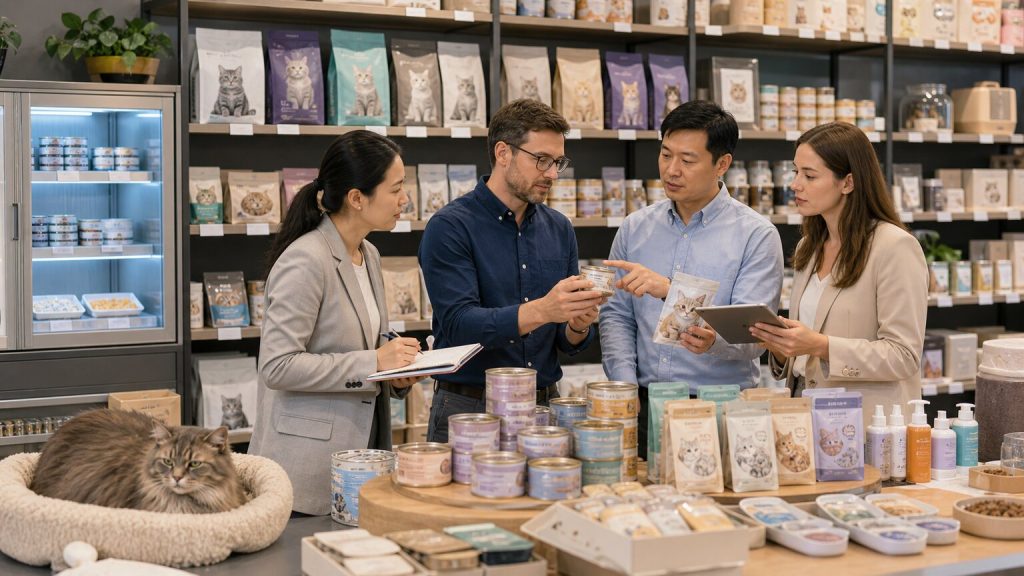
Private-label buyers should enter senior cat nutrition with a more disciplined brief than they would use for a standard flavor extension.
The first question is product role. Is the SKU a complete senior wet food, an adult maintenance food with senior-friendly texture, a complementary hydration product, a topper, a supplement, or a veterinary-positioned diet? Each choice affects formula, label, claims, documentation, channel, and liability.
The second question is evidence. What nutritional standard or formulation basis supports the product? Has the supplier produced similar senior, veterinary, or sensitive-positioned wet food before? What palatability data, stability data, shelf-life data, or batch records can be reviewed? Who approves claims before printing the label?
The third question is supply-chain repeatability. Can the factory maintain texture and fill consistency across batches? Can it support smaller trial runs before scale-up? Are cans, trays, cartons, labels, and multipack materials available consistently? What happens if a protein source, additive, or packaging material changes?
The fourth question is market localization. Senior cat nutrition in China, the U.S., the EU, Southeast Asia, and the Middle East will not use the same claim language, preferred pack size, or price architecture. A product that works on one platform may need meaningful adjustment for another market.
The Bigger Strategic Shift
The senior cat wet food signal is important because it shows the pet food market becoming more like human food and healthcare in one specific way: the consumer is starting to think in life stages, routines, and risk management.
That does not mean pet food should become medicalized everywhere. It means pet brands need more precise product logic. A generic senior label will be easy to copy. A well-built senior platform – with clear product roles, strong texture work, credible formulation, careful claims, channel education, and reliable supply – will be harder to copy.
For overseas buyers, the opportunity is not simply to source “senior cat food.” The opportunity is to build a senior pet nutrition assortment that makes sense: complete wet food, portion-controlled formats, hydration support, gentle texture, selected supplements, and clear retailer education. For manufacturers, the opportunity is to become the supplier that understands these trade-offs before the buyer asks.
Senior cat complete wet food may be the first product to break out in the current data. The larger opportunity is senior pet lifecycle commerce. That market will reward brands that combine empathy with formulation discipline, and suppliers that can turn a sensitive consumer need into safe, repeatable, well-documented products.