
On July 27, 2026, Central Garden & Pet announced a definitive agreement to acquire a majority interest in Germany-based TRIXIE Heimtierbedarf. The announcement is important not because it creates another headline about consolidation, but because it makes visible the assets that a serious pet-supplies platform needs to grow across regions.
Central describes TRIXIE as a European pet-supplies and pet-snacks business with close to 600 employees, more than 30,000 pet-retail customers internationally, a catalogue of more than 6,000 products, and an own-brand portfolio accounting for about 90% of sales. It also says TRIXIE introduces roughly 500 new products each year and will retain its leadership team after closing, subject to the required approvals and customary conditions. Those facts describe more than a brand collection. They describe an operating system for developing, buying, storing, selling, and replenishing a broad range of pet products.
For factories, sourcing teams, distributors, and private-label operators, the useful takeaway is straightforward: scale in pet supplies is built through product and channel capability working together. A large catalogue on its own is not a durable advantage.

Market Access Needs Operating Assets
It is tempting to treat cross-border expansion as a product problem. A company has a successful domestic range, finds manufacturing capacity, ships samples, and looks for retailers abroad. That sequence misses the difficult middle: market access is made practical by a local organisation that understands assortment, channels, delivery, product information, and the commercial expectations of each customer.
TRIXIE gives Central a platform with an established specialist-retail footprint in Europe. Central’s announcement specifically points to TRIXIE’s category expertise, retail relationships, logistics, and fulfilment capabilities as reasons the combination can support expansion. That is why the transaction matters to a supplier in China, Southeast Asia, Europe, or North America. A regional operator with this kind of reach does not need only a low ex-works quote. It needs products that can be placed responsibly into a defined range and serviced across many accounts.
The market context also matters. Central describes the European pet supplies and snacks market as approximately EUR 10 billion in annual sales and expects mid-single-digit growth. Europe is not one uniform retail environment: product rules, language, retailer formats, price expectations, and fulfilment routes vary significantly. A local platform reduces that operating distance, but it does not remove the need for a supplier to prepare well.
For manufacturers selling into Europe, our guide to EU GPSR compliance for pet-product buyers remains relevant. Product safety and documentation are only one part of access; the commercial partner must still be able to range, present, replenish, and support the item in the appropriate channel.
A Catalogue Is Not the Same as a Category System
More than 6,000 products sounds like scale, but the number by itself says little about commercial quality. A broad pet-supplies range needs a disciplined category system behind it: clear product roles, comparable specifications, range architecture, price positions, seasonal planning, and a way to retire or improve weak products.
Consider the mix implied by the TRIXIE announcement: dogs, cats, birds, reptiles, and small animals; accessories, toys, treats, habitats, apparel, bedding, and travel solutions. These groups do not share one buyer brief. A soft bed needs different materials, packaging, durability checks, and replenishment logic than a leash, a reptile habitat, or an enrichment toy. A supplier that treats all of them as generic pet accessories is unlikely to become an effective long-term partner.
For a product-development or sourcing team, the right questions are more specific:
What job does the product perform in the assortment? A good proposal identifies a genuine gap or an upgrade path, rather than adding another near-identical SKU.
Which retailer and consumer setting is it designed for? Independent specialty retail, a value chain, an ecommerce listing, and a premium lifestyle store can need different packaging, price points, stock depth, and merchandising support.
Can the supplier keep the specification stable? Materials, components, colour, packaging, artwork, and test evidence need a controlled change process. A late substitution can damage a retailer relationship more quickly than it reduces a factory cost.
Can the product be replenished as planned? A good sample is not enough. The buyer needs clear lead times, reasonable minimums, replacement-part logic where relevant, case-pack discipline, and a realistic capacity view.
This is also why pet furniture needs a different development conversation from small accessories. In our look at custom pet furniture manufacturing in China, we focus on user needs, stability, materials, customisation, and transit performance. Those same details determine whether a product can sit credibly within a larger specialist-retail range.
Product Development Is Part of Distribution Strength
Central says TRIXIE’s in-house design team introduces around 500 products per year. The useful signal is not that every distributor should chase that speed. It is that product development and distribution are linked: a retailer will give attention to newness only when the item has a clear category role, credible product information, adequate stock, and practical support after delivery.
For overseas manufacturers, this changes how development should be presented. A winning proposal should describe more than a product image and a unit price. It should show the intended user and channel, materials and construction choices, test or inspection approach as applicable, packaging and carton logic, expected order rhythm, and what will happen if a component or material needs to change.
The best partners also make product feedback usable. When a distributor reports repeat returns, fit issues, assembly problems, damaged cartons, or slow movement, the supplier needs a route to investigate the right cause. It may be a product feature, packaging design, factory process, retailer positioning, or unclear instructions. Treating every issue as a sales problem wastes the operational learning that a multi-country platform can provide.

Logistics Is a Commercial Promise, Not Back-Office Work
A deal like this is also a reminder that distribution capacity has commercial value. Central highlights TRIXIE’s logistics and fulfilment capabilities because specialist retail depends on reliable availability. An independent retailer does not need a global supplier relationship in the abstract; it needs the correct assortment to arrive in a usable condition, in the expected quantity, at the time its customers need it.
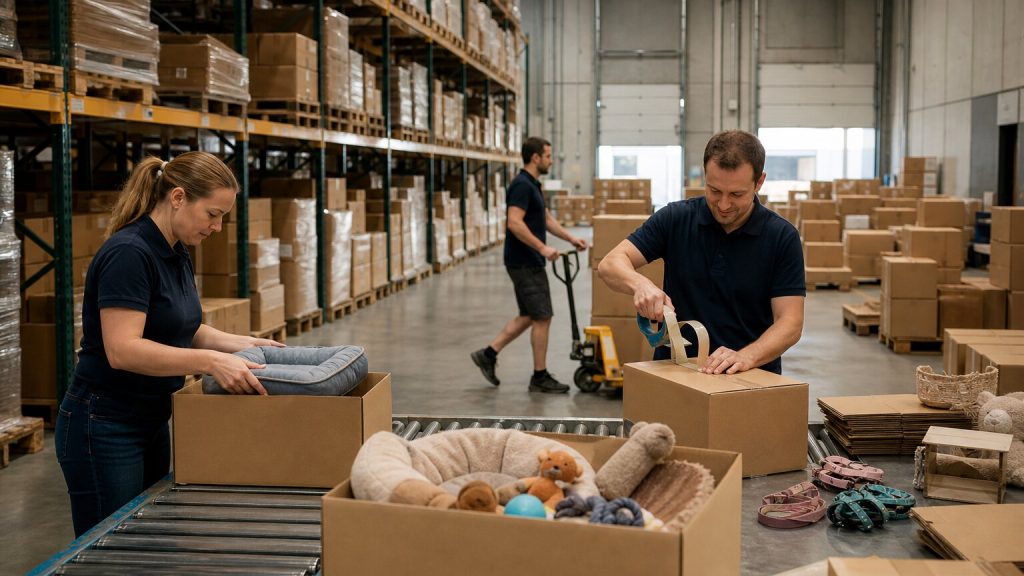
That requirement reaches upstream. A manufacturer should understand how its carton will be stored, picked, delivered, and replenished. Oversized outer cartons, weak transit packaging, poor barcode placement, mixed product versions, incomplete parts, inconsistent packing lists, and unmanaged order changes can all create expense downstream. They also make it harder for a distributor to protect service levels across a broad account base.
For a buyer assessing a new factory, the relevant evidence is practical: sample-to-production consistency, packaging tests appropriate to the route, carton and pallet specifications, spare-part or replacement-component planning where needed, photo records, inspection gates, and a named response path when a shipment is wrong. Our guide to pet factory tours and buyer due diligence explains why these checks need to go beyond a well-presented showroom or a passing social audit.
The goal is not to push every risk onto the factory. A capable distributor also needs sound forecasts, clear order terms, realistic launch timing, and a process for deciding what to do with slow-moving or superseded stock. The strongest commercial relationships are explicit about who owns each part of the service promise.
The Supplier Opportunity Is Bigger Than a First Purchase Order
Large distribution platforms can create meaningful opportunities for product suppliers, but winning a first listing and becoming a repeat supplier are different achievements. A buyer may trial a supplier for a narrow category or a seasonal programme before offering larger range responsibility. That is commercially sensible: it tests product accuracy, communication quality, documentation, delivery performance, and the supplier’s ability to improve.
Suppliers that want to work with multi-market distributors should prepare for that progression. They should be able to show:
A category-relevant capability statement. Avoid sending a generic catalogue. Lead with the products, materials, production methods, and packaging capabilities that fit the buyer’s actual category.
A controlled product-data package. Include dimensions, materials, care or use information, pack configuration, relevant safety or quality documentation, and clear ownership of artwork and revisions.
A disciplined development route. Define prototype stages, sample approval, testing or inspection as appropriate, first-order controls, and how changes will be reviewed before release.
A dependable service model. Explain capacity, lead time, minimum order quantity, shipping readiness, response time, nonconformance handling, and whether replacement parts or components can be supported.
A willingness to learn from sell-through. The supplier does not need access to every retailer’s data. It does need the maturity to act on returned-product patterns, quality findings, and category feedback instead of defending an original design at all costs.
Integration Is a Test, Not an Automatic Synergy
The Central-TRIXIE transaction is subject to approvals and is expected to close in the first half of Central’s fiscal 2027. It should therefore be discussed as a planned transaction, not a completed integration. Even after closing, the promised value depends on execution.
Combining a North American platform with a European specialist supplier can create real opportunities in sourcing, product development, and route to market. It can also expose differences in item data, supplier relationships, product standards, purchasing processes, system quality, and customer expectations. The fact that TRIXIE’s existing leadership is expected to continue is commercially meaningful, but continuity does not replace a deliberate operating plan.
For suppliers and distributors watching the deal, the useful question is not whether a larger company will exist. It is which capabilities the combined business will need more of: repeatable product development, clearly documented compliance, adaptable packaging, reliable regional fulfilment, and supplier partners that can cooperate across time zones without losing control of the detail.
Our View
The Central-TRIXIE deal shows why the next stage of pet-supplies competition is not simply about adding products or entering another country. Durable expansion needs a category system, credible product development, supplier controls, a local customer base, and a distribution operation that can keep promises to retailers.
For manufacturers, that is an invitation to raise the quality of the offer. The most valuable supplier is not the one with the longest catalogue or the lowest initial quote. It is the one that makes a distributor’s range easier to buy, safer to manage, more reliable to replenish, and easier to improve over time.
Sources and Reading
Pet Food Processing: reported transaction overview and company background, July 2026
Chinese industry commentary used as the editorial lead, Sohu
Follow Pet Industry Insights on Facebook for more global pet-industry analysis.