
Pet food storage and feeding products are easy to underestimate. A storage bin looks like a container. A scoop looks like a scoop. A bowl looks like a bowl. A feeding mat looks like a household accessory. But for many pet owners, these products sit at the center of daily feeding, freshness, cleanliness, portion control, and food-safety routines.
That makes the category more important than it appears. Pet food storage containers, airtight bins, treat jars, measuring scoops, stainless steel bowls, silicone mats, drying racks, bowl stands, and cleaning accessories are not simply add-ons next to pet food. They are the hardware layer around recurring food purchases.
For global buyers and distributors, this category can be attractive because it connects repeat household behavior with relatively durable goods. But the same routine-driven logic also raises the bar for materials, sealing, cleaning, packaging language, and product fit.
Why storage and feeding hygiene are becoming visible
Food safety guidance gives this category a practical foundation. The FDA advises pet owners to store dry pet food and treats in a cool, dry place, keep dry food in its original bag, and place that bag inside a clean, dedicated plastic container with a lid. FDA safe-handling guidance also emphasizes washing hands after handling pet food and treats.
The CDC similarly advises storing pet food and treats in a cool, dry place and washing pet food bowls and scooping utensils with soap and hot water after each use. The AVMA also highlights safe handling of pet food and treats, including handwashing and clean feeding practices.
For buyers, the takeaway is not that every container becomes a medical product. The point is that storage and feeding products support a documented daily behavior. The best products make safer routines easier: keep the original bag, close the lid, use a dedicated scoop, wash bowls, separate pet food tools from human food tools, and avoid messy feeding areas.
This is why the category deserves more attention than generic housewares sourcing.
The product system is bigger than a storage bin
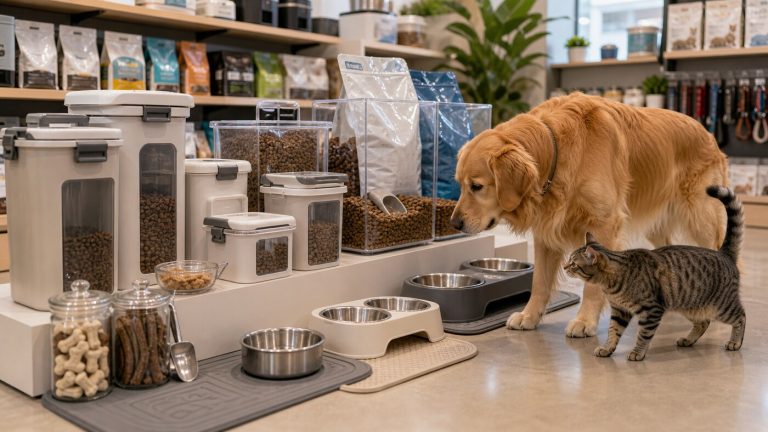
Pet food storage is often reduced to one large container, but the complete product system includes several connected formats.
Airtight storage bins are the hero product. They compete on seal performance, lid usability, wheel durability, transparency, odor control, bag-in-bin fit, capacity accuracy, and whether the owner can easily clean the interior. A bin that looks good but cannot hold a standard bag format neatly may frustrate consumers.
Measuring scoops and portion tools influence daily use. Dedicated scoops reduce cross-use with human kitchenware and help owners keep feeding more consistent. But they need smooth edges, volume markings that are accurate enough for practical use, and material that is easy to wash.
Bowls and bowl sets are another layer. Stainless steel, ceramic, silicone, and plastic formats all have different cleaning, durability, weight, noise, and perceived-quality tradeoffs. Some bowls are chosen for hygiene. Others are chosen for anti-slip features, raised feeding stations, travel use, or pet comfort.
Feeding mats, splash guards, drying trays, treat jars, and cleaning brushes complete the routine. These products may look low value individually, but they help build a coherent feeding station.
The strongest assortment is not just “more containers.” It is a complete feeding hygiene setup.
Original-bag compatibility matters
One of the most practical details in FDA storage guidance is the recommendation to keep dry pet food in its original bag, then place that bag into a clean, dedicated container. The original package contains key product information such as lot number, best-by date, manufacturer details, and feeding information.
That has direct design implications. A storage bin should be evaluated by whether it can hold common bag sizes without forcing owners to dump kibble loose into the bin. Dumping food into a container may look tidy, but it can separate food from traceability information and can leave oils or crumbs in the container if cleaning is poor.
For buyers, this creates a meaningful differentiation point. A bin designed around real bag dimensions, easy bag access, secure lid closure, and a scoop holder can communicate a more responsible routine. A generic plastic tub with a pet label cannot.
This is also where packaging language matters. A product can say it is designed to help organize pet food storage, support sealed storage, or hold an original bag inside. It should avoid implying that the container extends shelf life beyond the pet food manufacturer’s own guidance unless the claim is substantiated.
Materials and cleaning define trust
Storage and feeding products are close to food. That makes material selection central.
For plastic containers and scoops, buyers should ask about resin type, odor, pigment, food-contact suitability, lid gasket material, latch durability, and cleaning instructions. For silicone mats, flexibility, smell, dust attraction, heat resistance, dishwasher guidance, and edge curl matter. For stainless bowls, steel grade, finish quality, edge smoothness, rust risk, and base bonding are important.
The category is full of small review triggers. A container that smells strongly out of the box, a silicone mat that collects hair, a bowl that rusts around the rim, a scoop that cracks, or a lid that loses its seal can quickly undermine trust.
This connects naturally with our article on pet enrichment feeding products. Many enrichment feeders, lick mats, and slow feeders also touch food. In both categories, material documentation, cleaning behavior, and realistic use instructions can matter as much as shape.
Feeding stations are becoming organized routines
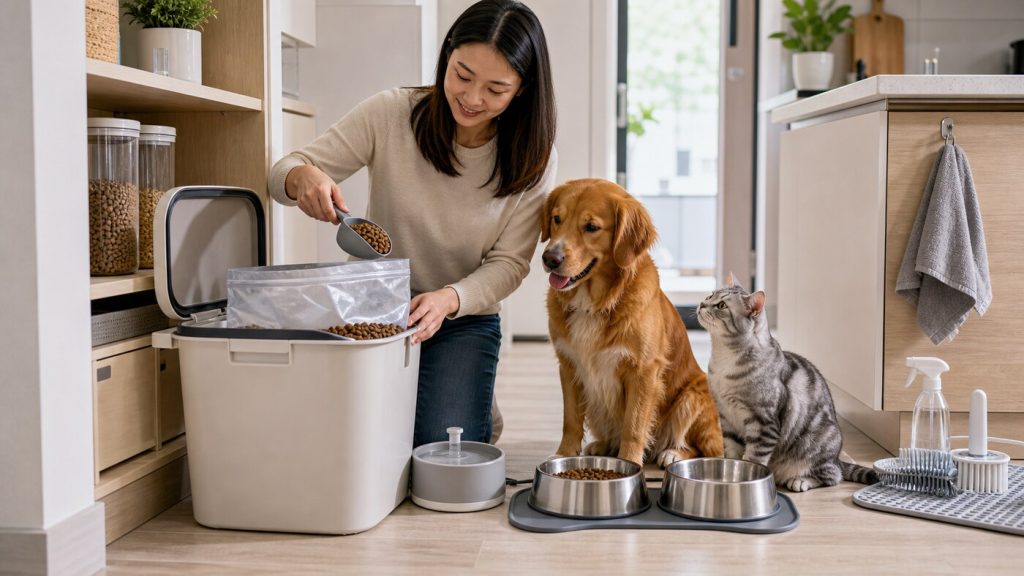
Owners increasingly think about the feeding area as a small household station. The station may include dry food storage, treat storage, bowls, water, mats, scoops, wipes, towel hooks, and sometimes supplements or dental products.
This creates an opportunity for buyers to build coordinated assortments. A basic set might include a bin, scoop, bowl pair, and mat. A premium set might include a transparent container, gasket lid, stainless bowls, raised stand, treat jar, and cleaning brush. A small-space urban set might use stackable containers and compact mats. A cat-focused set might prioritize smaller portions, odor control, and easy cleaning.
The category also fits subscription and pet food retail partnerships. A pet food brand may not manufacture storage hardware itself, but a retailer can use storage products to improve the food routine. Ecommerce operators can bundle storage and feeding products with first-time pet owner kits or food transition content.
Our article on pet oral care as a repeat-purchase category made a similar point: routine products work when the product lowers friction. Storage and feeding hygiene products do the same for daily meals.
Claims should be precise
Because the category sits near food safety, buyers should keep claims conservative.
“Airtight” should be supported by a reasonable seal design. “Food safe” should be backed by material documentation. “Odor proof” should not be used casually if the product only has a basic lid. “Keeps food fresh longer” should be treated carefully because food freshness depends on the food formula, packaging, storage conditions, time after opening, and manufacturer guidance.
Better claims are practical and observable: gasket lid, dedicated scoop, bag-in-bin design, easy-clean interior, dishwasher-safe bowl, non-slip mat, removable liner, stackable format, clear capacity, and easy access. These claims are easier to defend and more useful to buyers.
This is also relevant to compliance. In our article on EU GPSR and pet product compliance, we argued that product information and traceability should not be improvised after production. Feeding and storage products are a clear example: material, warnings, cleaning instructions, and intended use should be designed early.
QC should match real household use
Inspection should go beyond appearance.
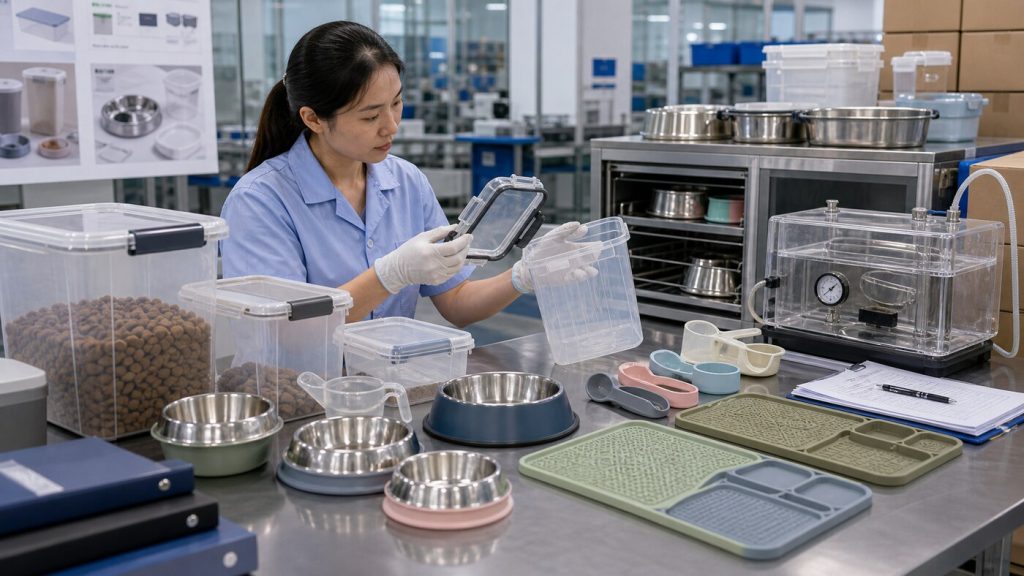
For storage bins, buyers should test lid fit, gasket compression, latch cycles, wheel strength, handle load, drop resistance, odor, stain resistance, and cleaning access. The product should be checked with real pet food bags, not only empty dimensions.
For bowls, buyers should test rim finish, base bonding, anti-slip performance, rust resistance, dishwasher behavior, noise, and packaging protection. For silicone mats, edge flatness, flexibility, odor, color transfer, heat tolerance, and surface texture matter.
For scoops and treat jars, edge smoothness, volume consistency, cap fit, transparency, and cracking behavior should be reviewed. For feeding stations, assembly quality, wobble, finish, and cleaning access become important.
This is not excessive. The category lives in repeated daily use. Small flaws are noticed quickly because the owner touches the product every day.
Channel strategy should follow the food routine
Pet food storage and feeding hygiene products can work in multiple channels, but each channel needs a slightly different story.
Pet specialty stores can build the category around feeding stations, new pet owner kits, food organization, and hygiene routines. Ecommerce can use comparison charts for capacity, dimensions, material, bag compatibility, and cleaning. Supermarket and club channels may prefer larger bins and simple bowl sets. Premium independent retailers can sell coordinated home-friendly storage designs.
The category also supports content. Retailers can explain why keeping the original bag matters, how to clean bowls and scoops, how to choose container capacity, and how to avoid mixed-use kitchen tools. That type of content is more useful than another generic “fresh food” claim.
The category connects with cat litter as a supply chain category in one practical way: weight, household storage, odor, packaging, and repeat purchase all shape consumer satisfaction. Different products, similar operational logic.
Buyer questions before scaling
Before placing large orders, buyers should ask:
Does the container hold common original bag sizes? What material is used for the bin, lid, gasket, scoop, bowl, or mat? Is food-contact documentation available where relevant? How does the product smell after unpacking? Can the owner clean it easily? What are the real capacity and external dimensions? How strong are the latch, hinge, wheel, handle, and scoop?
Buyers should also ask how the product will be described online. If the listing says “airtight,” “food safe,” “freshness,” or “odor control,” the product should support that language. If the product is meant to hold the original bag, the images should show that routine clearly.
The best products in this category make daily feeding feel organized, clean, and trustworthy. That is the value proposition.
Our view
Pet food storage and feeding hygiene products are becoming a trust category because they surround one of the highest-frequency behaviors in pet ownership: feeding. The products are not glamorous, but they are touched every day, seen in the home, and judged quickly when they smell, leak, rust, wobble, or become hard to clean.
For global buyers, the strongest opportunities are practical: bag-in-bin storage, reliable seals, dedicated scoops, easy-clean bowls, non-slip mats, coordinated feeding stations, and clear instructions. The weaker path is to treat the category like generic plastic housewares with pet graphics.
Our view is that this category rewards operational detail. The winning products will be the ones that make pet food routines easier to manage while respecting food-safety guidance, traceability information, material expectations, and real household cleaning behavior.
References
FDA guidance on proper storage of pet food and treats