
Pet enrichment products used to sit loosely in the toy aisle. A puzzle feeder was a toy. A slow feeder was a bowl. A lick mat was an add-on. A snuffle mat was a novelty. That view is becoming too narrow.
Enrichment feeding products now sit between toys, feeding accessories, behavior support, and household routines. They are bought to slow eating, keep pets occupied, support foraging behavior, reduce boredom, and make daily feeding more interactive. For buyers, that creates a category with strong retail appeal but more technical risk than a standard toy.
The opportunity is not simply to add more shapes. The stronger opportunity is to build products that match species behavior, food type, cleaning habits, material safety, supervision needs, and real household use.
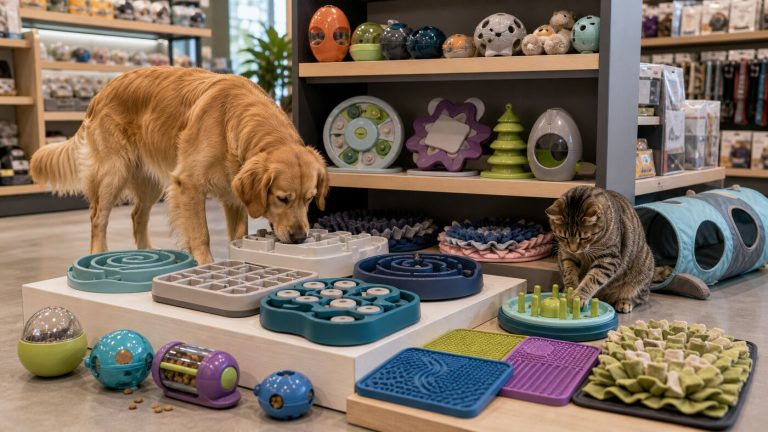
Why enrichment feeding is becoming a real category
The behavioral logic is not invented by retailers. The ASPCA notes that every meal can be an opportunity for enrichment and that food puzzles can slow down a dog’s eating while providing mental stimulation. The AAFP and ISFM feline environmental needs guidelines recommend puzzle feeders and timed feeders as part of feeding strategies for cats, and also warn that toys with ingestible parts should be managed carefully.
That combination is important. The category has a genuine welfare and routine-building story, but it also has safety boundaries. A product can be useful only when the design fits the animal, the food, and the owner’s ability to supervise and clean it.
For buyers, this makes enrichment feeding different from ordinary impulse toys. The product often touches food. It may be chewed, licked, scratched, washed, frozen, filled with wet food, or left on the floor. It may be used by puppies, kittens, seniors, strong chewers, anxious pets, or multi-pet households. Those use cases make material and design decisions commercially meaningful.
The category includes several product lanes
Enrichment feeding is not one product type. It is a portfolio.
Slow feeder bowls are designed to make pets work around ridges, mazes, or raised patterns during meals. They compete on bowl geometry, difficulty level, food compatibility, anti-slip base design, cleaning, and portion capacity. A good slow feeder should slow the routine without creating frustration or making cleaning unreasonable.
Puzzle feeders and treat-dispensing toys require pets to move parts, nudge compartments, roll a toy, or solve a simple task to access food. They compete on difficulty progression, noise, durability, stability, reset time, and whether the mechanism can trap food residue.
Lick mats are often used with wet food, spreadable treats, or frozen toppings. They compete on silicone quality, suction strength, texture depth, freezer behavior, dishwasher guidance, and whether the mat stays in place. For buyers, lick mats are closer to food-contact products than ordinary toys.
Snuffle mats and foraging textiles use fabric folds, fleece strips, or pockets to hide kibble and treats. They compete on stitching, washability, odor control, anti-slip backing, loose-fiber risk, and whether the design is easy enough for the pet to use but durable enough for repeated sessions.
Cat puzzle feeders and hunting-style feeders need different thinking from dog products. Cats may prefer smaller, more frequent food access, and many designs need to support natural foraging without intimidating the cat. A dog puzzle simply resized for cats may not be a good cat product.
Product design should follow behavior, not trend labels
Retail labels can become vague quickly. “Mental stimulation” sounds useful, but buyers should ask what behavior the product actually supports.
Is it slowing fast eating? Encouraging sniffing? Supporting licking and calming routines? Making indoor cats work for food? Keeping a dog occupied during grooming? Helping owners rotate feeding methods? Each use case changes the product requirements.
For example, a slow feeder for dry kibble needs different geometry from a lick mat used with wet food. A snuffle mat for small dogs needs different pocket depth and textile density than one for a large dog. A puzzle feeder for cats should not rely on heavy sliding mechanisms that frustrate timid animals. A treat ball should not have openings that trap food and create hygiene problems.
This is where the category connects with our article on pet oral care as a repeat-purchase category. Both categories sell better when the product becomes part of a routine. If the item is too difficult, too messy, too hard to clean, or too easy to destroy, the routine breaks.
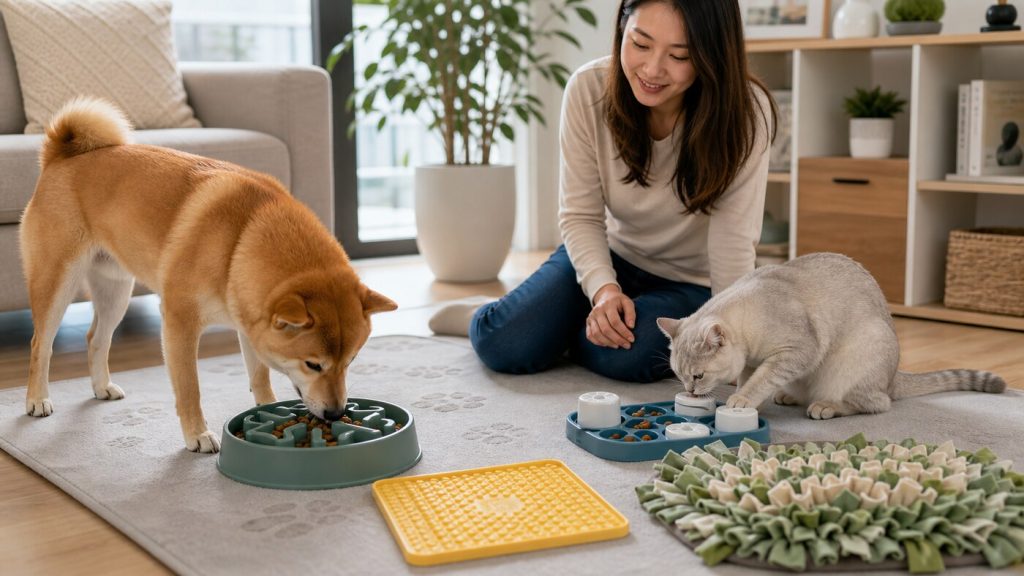
Safety is a design and sourcing issue
Enrichment products create several safety questions that buyers should not push to the end of development.
Small detachable parts are an obvious concern. Sliding caps, bells, loose knobs, squeakers, plastic inserts, and decorative elements can become ingestion risks if the product is chewed or poorly assembled. American Humane’s toy safety guidance emphasizes durable, non-toxic materials, avoiding items that are small enough to swallow, supervising new toys, inspecting wear and tear, and replacing damaged products.
Material choice is another issue. Many enrichment products touch food directly, especially lick mats, slow feeders, puzzle bowls, and treat toys. In the U.S., FDA food-contact inventories and 21 CFR-listed food contact substances show why “food-grade” language should be backed by material documentation, not used casually. Buyers should ask suppliers for material declarations, test reports, intended-use conditions, and temperature assumptions, especially for silicone, TPE, PP, ABS, coatings, pigments, and adhesives.
Durability also matters. A product that is safe for supervised light licking may not be safe for unsupervised chewing. A snuffle mat that is fine for gentle foraging may fail with a dog that pulls fabric strips aggressively. Packaging should communicate supervision and suitability clearly.
This connects with our article on EU GPSR and pet product compliance. For enrichment products, traceability, warnings, age/size guidance, material documentation, and responsible claims are part of the commercial product.
Cleaning can decide repeat use
Enrichment products often fail because owners do not want to clean them.
This is especially true for lick mats and wet-food puzzles. Deep grooves may look impressive, but if food residue remains after washing, reviews suffer. Dishwasher-safe claims should be checked against actual material behavior. Silicone may attract dust or hair. Textiles may hold odor. Suction cups may weaken after repeated washing. Puzzle mechanisms may trap crumbs and moisture.
For buyers, cleaning is not a minor convenience feature. It affects repeat use, return rates, and whether the product earns positive reviews. A product that works once for a video but becomes unpleasant after a week is not a strong SKU.
Cleaning also affects channel strategy. Ecommerce listings can show washing videos and use instructions. Pet specialty stores can display sample textures and explain food compatibility. Veterinary or training channels may prefer simpler, more reliable designs that are easier for owners to follow.
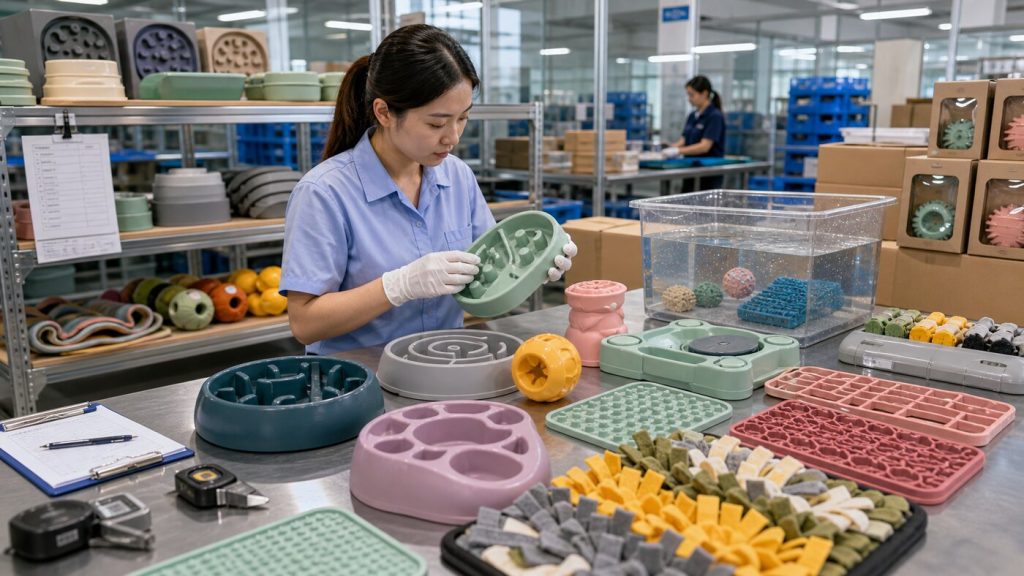
QC should focus on failure points
The best inspection plan depends on the format.
For plastic puzzle feeders, buyers should check edge smoothness, sliding-part tolerance, small-part retention, noise, stability, reset function, dishwasher or hand-wash guidance, and whether food can get trapped in seams. For silicone lick mats, suction strength, thickness, flexibility, odor, pigment migration documentation, freezer behavior, and washing durability matter.
For snuffle mats, stitching density, fabric shedding, backing grip, wash shrinkage, odor, and loose thread risk should be tested. For treat balls and dispensing toys, opening size, chew resistance, bounce behavior, and cleaning access are key.
Packaging should also be evaluated. If the product needs supervision, the box and listing should say so. If it is not suitable for aggressive chewers, that limitation should be visible. If food-contact materials are used, the buyer should understand the intended conditions of use.
Claims should stay realistic
The enrichment category is vulnerable to overclaiming. “Reduces boredom” or “supports mental stimulation” can be reasonable when framed as routine support. But stronger claims about anxiety, behavior treatment, digestion, weight loss, or medical outcomes should be handled carefully.
Buyers should ask what claim the product can support. A slow feeder can be described around slower eating behavior if the design supports it, but it should not be presented as a medical product. A lick mat may help create a longer licking routine, but it should not be treated like a behavior therapy tool unless the claim is properly supported. A puzzle feeder can encourage problem-solving, but difficulty should match the pet.
This is especially important for marketplaces where images, videos, influencer scripts, and bullet points all become part of the claim environment. The most durable brands will use practical language: designed for supervised enrichment, helps extend mealtime, encourages foraging, suitable for dry kibble or spreadable treats, easy to clean, and choose difficulty by pet size and temperament.
Channel strategy should educate without overwhelming
Enrichment products need some education, but not too much. If the product requires a long explanation, conversion may suffer.
Retailers can group products by use occasion: slow eating, licking and freezing, sniffing and foraging, cat food puzzles, puppy starter enrichment, and boredom-busting rotation. That helps consumers understand why the product exists.
Bundles can work well. A starter enrichment kit might include a slow feeder, a lick mat, and a beginner puzzle. A cat kit might combine a low-frustration food puzzle, wand toy, and small treat dispenser. A grooming-support bundle might pair a lick mat with grooming tools, which connects naturally with our analysis of home pet grooming tools.
The category also supports repeat content. Product pages can show setup, cleaning, food examples, difficulty levels, and supervision guidance. This makes enrichment feeding more content-driven than many low-ticket pet accessories, a point that also links to our article on low-ticket pet accessories and ad economics.
Our view
Pet enrichment feeding products are becoming a routine-building category because they connect daily feeding with behavior, owner engagement, and indoor pet lifestyles. The category has strong commercial potential, but only when buyers treat it as more than colorful plastic.
For global buyers and distributors, the strongest assortments will be format-specific: beginner slow feeders, easy-clean lick mats, durable snuffle mats, cat-appropriate puzzles, and clear difficulty levels. The weaker path is to copy trendy shapes without thinking through food contact, small parts, cleaning, supervision, and claim language.
Our view is that enrichment feeding will reward products that are simple in the right ways: safe materials, clear use cases, easy cleaning, realistic claims, durable parts, and packaging that helps owners choose the right product for the right pet. That is what turns a novelty toy into a routine.
References
ASPCA canine enrichment guidance
AAFP and ISFM feline environmental needs guidelines