
Companion-animal medicine is becoming more advanced, but some of its most basic infrastructure is still uneven. Pet hospitals can now offer more surgery, oncology, imaging, dialysis, intensive care, and emergency medicine than in the past. Yet when a dog or cat urgently needs blood, many clinics still depend on improvised sourcing, owner networks, same-day donors, or regional availability rather than a reliable blood bank system.
That gap is the core issue raised in a recent Sohu pet-industry report on why blood for pets is still difficult to secure in China. The article describes a fragmented market where some hospitals rely on immediate collection and transfusion, owner mutual aid, informal donor providers, or other inconsistent sources. It also highlights efforts by specialized operators such as Guochong Blood to build more standardized canine and feline blood supply systems.
For overseas veterinary operators, clinic suppliers, cold-chain providers, diagnostic companies, investors, and B2B pet health service firms, the topic matters beyond one market. Pet blood banks are not a visible consumer category, but they are part of the infrastructure behind serious veterinary healthcare. Where blood supply is unreliable, advanced medicine has a weak link.

Why This Is Infrastructure, Not A Side Service
Blood transfusion is not a retail product. It is a clinical support system.
A pet hospital that performs emergency surgery, trauma care, oncology support, anemia management, or intensive care may need access to blood products quickly. If that access depends on finding a donor at the last minute, the clinic is operating with a fragile safety net. The problem is not only whether a donor animal exists. It is whether the donor is healthy, whether infectious disease screening is appropriate, whether the donor and recipient are compatible, whether the product has been collected aseptically, whether it has been stored correctly, and whether the clinic can monitor for transfusion reactions.
That is why pet blood banking belongs in the same infrastructure discussion as diagnostic labs, pharmacy channels, imaging equipment, emergency hospitals, and referral networks. It is not glamorous, but it determines whether more advanced veterinary care can function consistently.
This connects naturally with our earlier analysis of pet medicine portfolios and clinical-scenario coverage. As pet healthcare becomes more specialized, the market needs more than individual products. It needs systems that support real clinical workflows.
The Weakness Of Improvised Blood Sourcing
The Sohu report describes several current sourcing patterns: hospitals that keep internal donor animals, owners who search for donor pets through personal networks, informal providers who bring donor dogs to clinics, and other irregular channels. Each route may appear to solve an urgent case, but each also exposes structural risk.
The first risk is timing. Emergency medicine does not wait for a social-media search or a friend-of-a-friend referral. A clinic may need blood before the owner can find a compatible donor.
The second risk is donor health. A donor pet that looks healthy may still carry infectious disease risks, may be unsuitable due to medical history, or may not meet appropriate donor criteria. If donor screening is skipped, the recipient may face avoidable risk.
The third risk is compatibility. Canine and feline transfusion medicine involves blood typing, crossmatching, prior transfusion history, and monitoring. A last-minute donor is not automatically a safe donor.
The fourth risk is animal welfare. If donor animals are held primarily for blood collection without proper housing, nutrition, veterinary care, rest intervals, and ethical oversight, the supply chain becomes unacceptable even if it fills a short-term clinical need.
The fifth risk is traceability. If a blood product cannot be traced by donor, screening record, collection time, anticoagulant, storage condition, transport history, and recipient outcome, the system cannot improve reliably.
What Standards Already Signal
China is not starting from zero. The Chinese Veterinary Medical Association published an official notice in 2024 releasing several companion-animal group standards, including Technical Specification for Whole Blood Transfusion in Dogs and Cats and a guideline on adverse transfusion reaction classification.
That is an important step because it gives the clinical side a more formal reference point. However, clinical transfusion standards are only one part of a blood-bank system. The larger infrastructure question remains: how blood is collected, screened, processed, stored, transported, documented, and governed before it reaches the clinic.
The Sohu report makes the same distinction. A standard that tells clinicians how to perform transfusion does not fully solve blood production, donor management, transport, regulatory oversight, or long-term blood-bank economics.
For B2B readers, this distinction matters. A clinic standard creates demand for training and protocol compliance. A supply standard creates demand for collection systems, bags, cold storage, logistics, testing, data records, traceability, and quality control.
Donor Screening Is The First Trust Layer
The MSD Veterinary Manual’s section on screening blood donors and blood banking in dogs and cats states that donors require screening for good health and negative status for geographically relevant infectious diseases that could be transmitted through transfusion. It also notes that collected blood can be left as whole blood or separated into components such as packed red blood cells, plasma, and platelets.
This turns pet blood banking into a professional service, not a simple donor-matching business.
Screening requires health evaluation, infectious disease testing, donor records, species-specific criteria, and a process for excluding unsuitable donors. A dog or cat that can physically provide blood is not necessarily an acceptable donor. The operator needs medical oversight, not just access to animals.
For buyers and investors, donor screening is one of the first questions to ask. Who owns the donor protocol? Which diseases are screened in the target geography? How often is screening repeated? What donor welfare criteria apply? How are records stored? What happens if a donor later tests positive for a relevant pathogen? How does the company communicate risk to clinics?
These questions are not paperwork. They define whether the blood supply can be trusted.

Compatibility Testing Creates Product Confidence
Blood availability is not the same as blood compatibility.
Cornell University’s Animal Health Diagnostic Center describes crossmatch testing as a way to detect incompatibility between donor and recipient blood and guide transfusion decisions. The practical industry message is clear: serious transfusion workflows need testing capacity, not just inventory.
Compatibility testing affects how clinics use blood products, how emergency protocols are written, and how much confidence veterinarians have in a supply network. If a blood bank can provide screened products but a clinic lacks testing workflow, the system is still incomplete. If a clinic can test but has no reliable source of blood, the system is also incomplete.
This creates B2B opportunities beyond blood collection itself. Diagnostic kits, crossmatch services, lab analyzers, training programs, digital records, emergency-clinic partnerships, and referral-hospital networks all become part of the infrastructure.
It also changes the sales conversation. A blood-bank operator should not sell only units. It should sell confidence: donor screening, product documentation, compatibility workflow, cold-chain handling, clinical education, and adverse-event reporting.
Cold Chain And Component Therapy Matter
Blood products are biological materials. Storage and transport are not afterthoughts.
The MSD Veterinary Manual notes that red blood cell products are stored at 2-6°C for 21-42 days, while plasma storage follows frozen-product handling. It also explains that component therapy can replace only the blood components needed, helping reduce transfusion reaction risk and optimize blood resources.
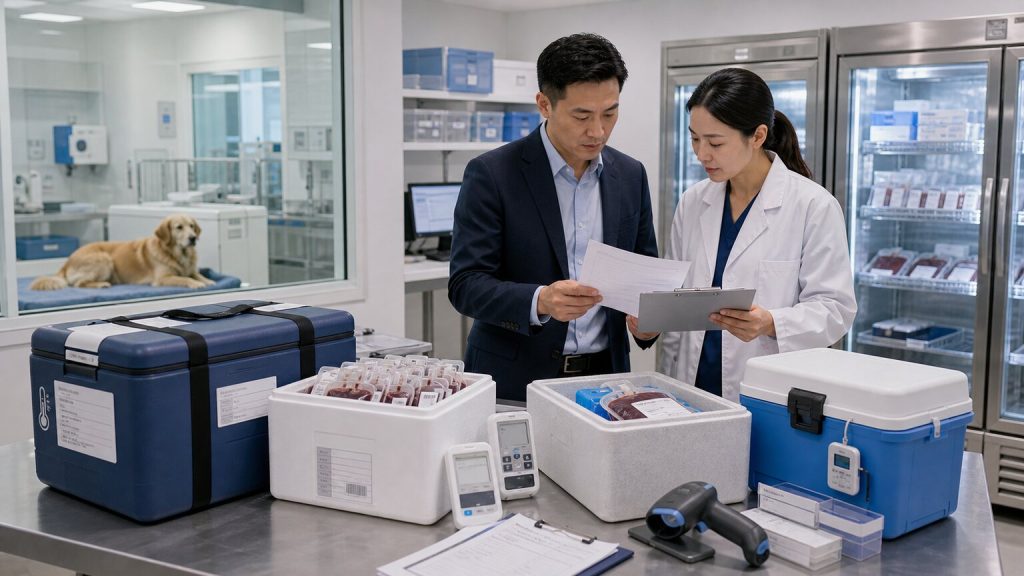
For the supply chain, this means the category has more in common with medical cold chain than with ordinary pet product distribution. Temperature monitoring, validated containers, refrigerator management, expiry control, product rotation, transport time, clinic receiving procedures, and recall capability all matter.
For clinics, component availability can improve resource use. Whole blood may be appropriate in some cases, but packed red blood cells, plasma, platelets, and other components can serve different clinical needs. A mature blood-bank system helps the clinic choose and manage product types rather than treating all blood as one generic emergency input.
For overseas suppliers, this is where equipment and services come in. Refrigeration, insulated transport boxes, temperature data loggers, barcode systems, chain-of-custody software, QA documentation, and training materials can become real business lines.
Animal Welfare Is A Structural Question
Pet blood banking cannot ignore donor-animal welfare.
Unlike human blood donation, dogs and cats cannot provide informed consent. That ethical difference does not make transfusion medicine impossible, but it raises the standard for how donor animals are selected, housed, monitored, rested, and protected. Any blood-bank model that relies on poor housing, excessive collection, weak nutrition, or opaque donor management will face legitimate criticism.
The Sohu article discusses public anxiety around informal donor animals and points to the tension between saving recipient pets and protecting donor pets. For an industry media site, the right framing is not to dismiss the concern or sensationalize it. The real question is governance: what welfare rules, veterinary checks, collection intervals, retirement policies, living conditions, and transparency should be required?
This is also a business issue. A blood-bank provider that cannot prove animal-welfare discipline will struggle to gain trust from clinics, regulators, owners, and investors. In a category where emotion and ethics are unavoidable, operational transparency becomes part of the product.
Community Donors And Closed Donor Colonies
The Sohu report describes two possible models used by specialized operators: community-style donor networks and closed donor centers.
A community donor model can expand access by registering suitable pets from the wider owner community. It may be less capital-intensive and can build public participation. But it requires appointment systems, screening, owner education, donor availability, transport logistics, and repeat testing.
A closed donor center offers more control over donor health, housing, collection schedules, and records. It may make blood availability more predictable. But it also requires higher welfare governance, facility investment, veterinary oversight, and public trust.
Neither model is automatically superior. The right answer may be regional. Dense urban clinic networks may support community donor systems. Emergency referral hospitals may need stored inventory and component products. Large markets may combine both.
For B2B readers, the operational design matters more than the slogan. Ask what problem the model solves: emergency availability, donor welfare, cost control, disease screening, traceability, or geographic coverage.
Why This Is Hard To Commercialize
Pet blood banking sounds like a clear unmet need, but it is difficult to commercialize.
The service sits between veterinary medicine, biological materials, animal welfare, logistics, public trust, regulation, and emergency care. It requires clinical expertise, donor management, testing, cold chain, software records, clinic education, and careful messaging. Demand can be urgent but uneven. Inventory can expire. Donor operations cost money. Regulation may be incomplete. Public opinion can shift quickly if welfare standards are unclear.
That explains why the market has not solved itself through simple supply and demand. The easiest informal solutions are often the least reliable. The most responsible solutions require capital, standards, and operational discipline.
This is similar to what we saw in pet pharmacy channel development. Health infrastructure does not scale like ordinary pet accessories. It needs classification, traceability, professional trust, and rules.
What Buyers And Operators Should Watch
For veterinary hospital groups, the first question is whether blood access is part of emergency readiness. A hospital that markets advanced surgery or emergency care should understand its blood sourcing plan, compatibility workflow, storage capability, and transfusion reaction protocol.
For distributors and service companies, the opportunity is not only in blood products. It is in supporting systems: collection equipment, blood bags, refrigerators, temperature monitoring, transport containers, barcode traceability, donor database tools, lab testing, SOP templates, and training.
For pet health investors, the question is whether a company is building a defensible infrastructure platform or only brokering urgent transactions. The stronger model will likely combine clinical credibility, supply reliability, welfare governance, and regulatory readiness.
For regulators and industry associations, the next step is to connect clinical standards with collection, processing, donor welfare, storage, transport, and adverse-event reporting. A transfusion protocol is valuable, but a blood-bank ecosystem needs standards across the chain.
For product suppliers, this topic also points to adjacent demand: emergency-clinic consumables, ICU monitoring, diagnostic kits, veterinary education, and cold-chain packaging. Pet healthcare infrastructure is not one category. It is a network of services and supplies that must work together.
The Bigger Industry Signal
Pet blood banks are a hidden infrastructure gap because most consumers do not think about them until an emergency occurs. But for the veterinary industry, they are a test of maturity.
If a market wants more advanced surgery, oncology, emergency medicine, and critical care, it needs the backend systems that make those services safer and more reliable. Blood supply is one of those systems. It requires standards, testing, logistics, donor welfare, and clinical education.
China’s discussion around pet medical blood supply is still developing, and one Sohu report is not a complete market map. But the broader signal is clear: as companion-animal medicine professionalizes, weak infrastructure becomes more visible.
For global operators, this is a useful reminder. The next pet healthcare opportunities will not all look like consumer products or apps. Some will look like refrigerators, testing protocols, donor databases, transport boxes, SOPs, training sessions, and professional service networks.
We will continue tracking veterinary infrastructure, pet health channels, and supply-chain changes through the site and our Pet Industry Insights Facebook page.