
Home pet grooming tools are easy to underestimate. A brush, comb, shampoo bottle, nail trimmer, clipper, towel, or wipe looks like a small accessory compared with pet food, smart devices, veterinary services, or large pet furniture.
But the category is becoming more important because it sits at the intersection of three durable behaviors: owners want pets to look and feel clean, professional grooming can be expensive or inconvenient, and many daily care tasks happen between formal service visits.
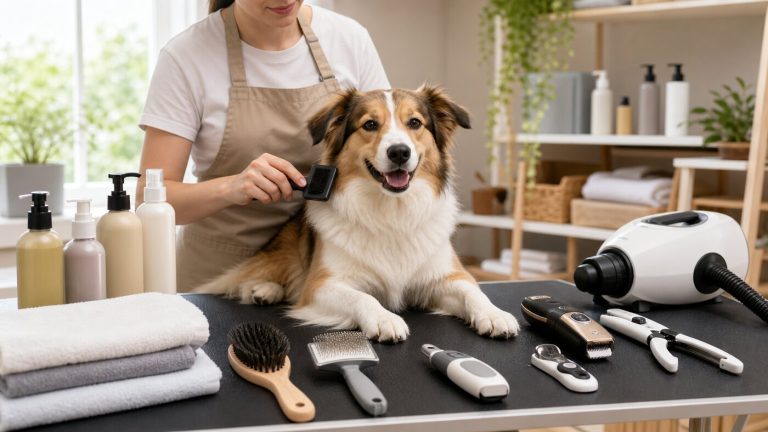
For overseas buyers, distributors, sourcing teams, private-label brands, and ecommerce operators, the useful way to look at grooming is not as a pile of low-ticket SKUs. It is a product system. The customer may start with one brush, but the real category includes coat care, nail care, bathing, drying, ear and paw cleaning, shedding control, sensitive-skin products, replacement blades, refill filters, wipes, towels, storage cases, and education.
That makes home grooming a better category than it first appears. It has repeat use, visible before-and-after value, bundle potential, and clear segmentation by pet type, coat type, owner confidence, and channel.
Why the category deserves attention
The American Pet Products Association reported that U.S. pet industry spending reached $158 billion in 2024. Within that, supplies, live animals, and OTC medicine accounted for $34.4 billion, while “other services” included grooming alongside boarding, insurance, training, pet sitting, and pet walking.
Those numbers do not isolate grooming tools, but they show the commercial environment around the category. Pet owners are spending both on physical supplies and on services. Home grooming tools sit between those two spending pools.
That middle position matters. A household may not replace a dog bed every month, but it may repeatedly buy shampoo, wipes, detangling spray, toothbrushes, blades, combs, towels, and nail-care accessories. A pet owner may not want to replace a professional groomer, but they still need tools for maintenance between visits.
The American Kennel Club notes that grooming frequency depends on breed, size, and coat type, and that routine grooming can help owners examine a dog’s coat, teeth, eyes, ears, and nails for signs of problems. The ASPCA gives similar practical guidance for cats, including brushing, nail trimming, and bathing precautions. For product companies, the lesson is not medical. It is behavioral: grooming is part of ongoing pet care, not only appearance.
A product system has more value than a single brush
The strongest grooming category strategy starts by separating use cases.
Coat care includes slicker brushes, pin brushes, bristle brushes, undercoat rakes, shedding blades, dematting tools, flea combs, and finishing combs. Nail care includes clippers, grinders, replacement heads, styptic powder, files, and training accessories. Bathing includes shampoo, conditioner, wipes, towels, silicone scrubbers, no-rinse foam, paw cleaners, and drying tools. Hair trimming includes clippers, trimmers, guide combs, blades, blade oil, cleaning brushes, storage cases, and charging accessories.
Each subcategory has different buyer logic. A slicker brush is a low-risk entry product, but it can create comfort complaints if pins are too sharp or the pad is too stiff. A nail grinder can command a higher price, but it must solve noise, vibration, battery life, heat, charging reliability, and pet anxiety. Shampoo creates repeat purchase, but it raises formulation, labeling, fragrance, skin sensitivity, and market-specific claim questions.
This is why grooming tools should not be managed like generic accessories. In our analysis of why low-ticket pet accessories stores lose money on ads, we argued that small products need bundle logic and stronger basket economics. Home grooming is a natural fit for that approach because products work together.
A grooming starter kit can include a brush, comb, nail trimmer, towel, wipes, and a storage pouch. A long-hair kit can include a slicker brush, dematting comb, detangling spray, and grooming guide. A small-dog maintenance kit can include a soft brush, face comb, gentle shampoo, paw wipes, and nail file. A private-label brand can also create refill logic around wipes, shampoo, blade oil, replacement heads, and consumables.
The buyer's risk is product fit, not only product cost
Grooming products generate complaints when they do not fit the animal, the owner, or the use case.
A brush that works for a short-coated dog may be ineffective or uncomfortable for a long-haired cat. A clipper that looks powerful in photos may pull hair if the blade quality is weak or the motor slows under thick coats. A nail grinder may be returned if the noise makes pets anxious. A shampoo may create bad reviews if the fragrance is too strong, the bottle leaks, or the label implies a skin claim the product cannot support.
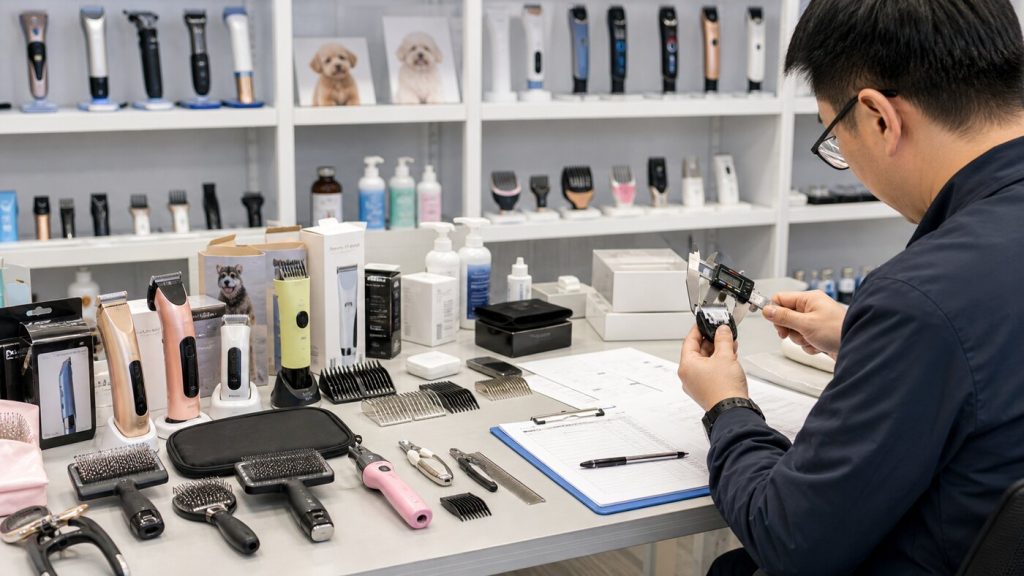
For sourcing teams, that means the product brief should be more specific than “pet brush” or “pet clipper.” Buyers should define the target pet, coat type, user skill level, channel, price band, packaging format, safety expectation, and after-sales risk.
For example, an Amazon private-label brush needs strong review performance and clear visual education. A supermarket grooming kit needs simple packaging and broad use. A pet specialty distributor may want better material quality, replacement parts, and professional-looking presentation. A veterinary-adjacent brand may need more careful wording and stronger documentation.
This is also where the broader pet supplies market is moving. In our article on China’s pet supplies market moving from volume growth to category upgrades, we argued that the next stage of growth comes from more specialized spending per pet. Grooming is one of the categories where specialization is visible.
What suppliers should be able to prove
The minimum supplier claim is “we can make grooming tools.” That is not enough for serious buyers.
For brushes and combs, suppliers should be able to discuss pin material, tip finishing, cushion flexibility, handle ergonomics, rust resistance, pull force, packaging protection, and coat-type suitability. For clippers and trimmers, buyers should ask about blade material, blade temperature during use, motor type, noise level, vibration, battery capacity, charging interface, adapter compliance, replacement parts, and warranty rate.
For nail grinders, noise and vibration deserve special attention. A quiet product is not just a marketing phrase. It affects whether the owner can actually use the tool. Buyers should request decibel measurements, sample videos, motor specifications, grinding-head durability, heat behavior, charging performance, and drop-test feedback.
For shampoos, wipes, and topical products, the supplier discussion changes again. Buyers need ingredient lists, fragrance options, preservative systems, packaging leakage tests, shelf-life data, claim review, market-specific labeling, and consistency across production batches. A product described as “gentle” or “sensitive skin” needs more discipline than a generic bottle design.
This does not mean every supplier must become a regulatory expert. But it does mean a supplier should understand what the buyer’s market will ask. Our article on EU GPSR and pet product compliance explained how safety information, traceability, warnings, and online listing details are becoming buyer-side concerns. Grooming tools are a practical example of that shift.
Electric grooming tools need a different sourcing process
Manual brushes and combs are mostly material and ergonomic products. Electric clippers, trimmers, grinders, dryers, and cordless grooming devices are different.
They involve batteries, motors, charging, adapters, heat, noise, moving parts, and sometimes water exposure. A buyer should not evaluate them only by catalog photos or factory price.
Key questions include: How long does the battery run under realistic load? Does the blade heat up after several minutes? Does the motor slow when cutting thicker hair? Can replacement blades be supplied for at least one or two years? Is the charging cable standard or proprietary? Can the product pass relevant electrical and battery documentation requirements for the target market? Does the packaging include safe-use instructions in the correct language?
Electric grooming tools also carry higher return risk. If the product disappoints, the return reason is often not subtle. Customers say it is too loud, weak, hot, rough, short-lived, hard to clean, or difficult to charge. That makes pre-shipment testing and sample evaluation more important.
For distributors, this is where supplier capability can become a moat. A supplier with stable components, spare parts, clear manuals, and good after-sales support is more valuable than a supplier with a slightly cheaper unit cost.
Retail channels want different grooming stories
Grooming products sell differently by channel.
Amazon and marketplace channels reward clear use cases, review-proof functionality, comparison photos, and bundles that improve average order value. The product page should show coat type, pet size, noise level for powered tools, cleaning method, and what is included in the box.
Pet specialty retail often needs stronger packaging and education. A shopper standing in a store wants to know whether the brush fits a long-haired cat, a shedding dog, a puppy, or a sensitive-skinned pet. Packaging that only says “premium grooming brush” is weak. Packaging that shows the use case clearly has a better chance.
Professional grooming and salon channels require a different level of durability. Clippers, blades, dryers, tables, restraints, and disinfectable tools may need higher quality than consumer kits. A supplier should not sell a consumer-grade tool as salon-ready unless it can support that claim.
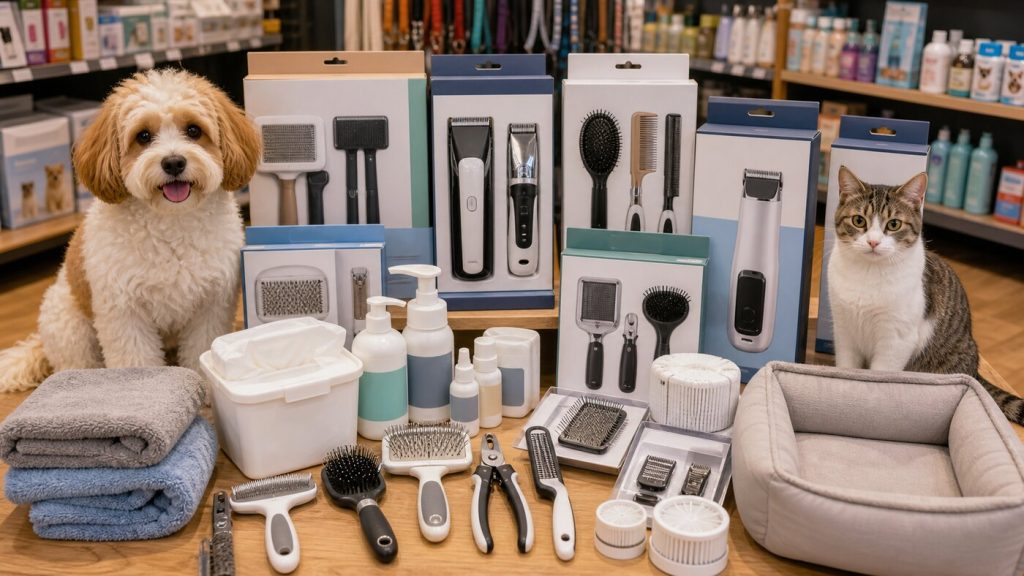
Independent ecommerce can use education more heavily. A brand can build content around “first grooming kit for a puppy,” “long-hair cat maintenance,” “between-groomer care,” “low-noise nail trimming,” or “travel grooming pouch.” This content-led approach is similar to the way outdoor pet gear needs visible scenes. In our article on dog camping beds and outdoor pet gear, we noted that the product becomes stronger when the use scene is obvious. Grooming works the same way.
The category is moving toward bundles and replenishment
One of the best reasons to take grooming seriously is that it can support replenishment.
A brush may be a one-time purchase, but shampoo, wipes, ear cleaners, toothbrushes, toothpaste, blade oil, replacement blades, grinder heads, filters, towels, and pads create repeat purchase or add-on sales. This makes grooming more interesting than many one-off accessories.
For private-label brands, the opportunity is to build a product ladder. Start with a kit, then offer refills, replacements, upgraded tools, breed or coat-specific bundles, and seasonal care products. For distributors, grooming can become a shelf system rather than a scattered product group. For suppliers, value comes from helping buyers build that system.
The mistake is to copy a popular grooming tool without understanding the surrounding routine. Owners do not buy grooming tools to own tools. They buy them to solve shedding, matting, odor, nail length, dirt, anxiety, seasonal coat changes, and between-visit maintenance.
That means the best product concepts start with the care routine, not the factory catalog.
Our view
Home pet grooming tools are not a niche side category. They are part of the everyday care infrastructure around pet ownership.
The category is attractive because it combines visual results, repeat use, bundle potential, consumables, and channel flexibility. It is also risky because poor product fit creates fast complaints. A brush that scratches, a clipper that pulls, a grinder that scares pets, or a shampoo that leaks can damage trust quickly.
For buyers, the practical move is to segment the category carefully: manual tools, electric devices, liquids and wipes, refill parts, starter kits, and professional-grade tools all need different sourcing questions.
For suppliers, the opportunity is to move beyond generic quotes and support buyers with use-case design, material explanation, sample testing, packaging logic, replacement parts, and market-ready documentation.
Pet Industry Insights expects home grooming to remain a useful category for global pet product operators because it connects emotional care with repeatable product demand. The brands and suppliers that win will be the ones that treat grooming as a system, not a shelf of disconnected accessories.
Reference
APPA pet industry market size and statistics