
Pet food innovation is often discussed as a battle between brands, formulas, and marketing claims. The more interesting change is happening one layer deeper: research infrastructure is starting to become part of the competitive environment itself.
That is why a recent source lead from Chongyejia on Sohu is worth watching beyond China. The article focused on Champion Petfoods, the company behind ORIJEN and ACANA, and its newly opened Global Innovation and Discovery Centre in Acheson, Alberta. The center matters not only because it adds more R&D capacity for a premium pet food group, but because part of the related university research is intended to be made available to the wider industry.
For overseas buyers, distributors, ingredient suppliers, private-label teams, and pet food entrepreneurs, the signal is bigger than one company. Open pet food research can become a practical supply chain tool. It can help smaller brands ask better questions, help suppliers document ingredients more clearly, and push the category away from pure concept marketing toward more evidence-based product development.
What Was Announced
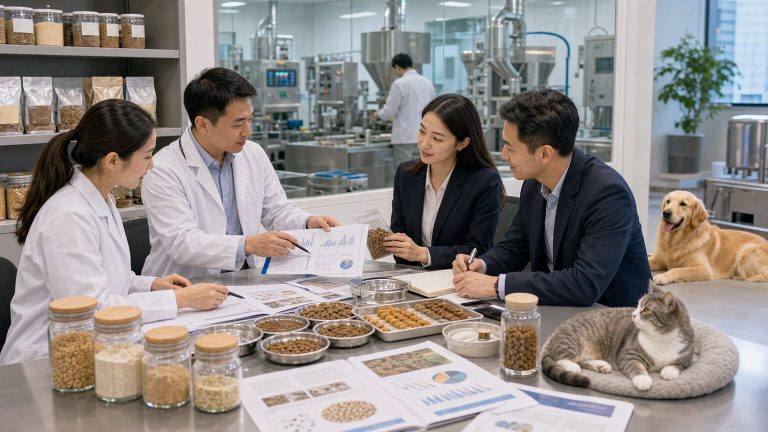
Champion Petfoods’ parent company Mars Petcare has publicly described the facility as a CAD 32 million Global Innovation and Discovery Centre in Acheson, Alberta. According to Mars’ announcement, the site is designed to support pet nutrition science, new product development, and innovation for Champion Petfoods’ premium portfolio.
The announcement also points to collaboration with researchers from the University of Calgary and the University of Guelph. Champion’s own material on its University of Guelph collaboration frames the relationship around advancing research in pet nutrition, ingredient quality, and health-linked outcomes.
The Sohu article highlighted a detail that deserves attention: collaborative research findings are not being treated only as private corporate know-how. The Mars announcement states that many findings from the university partnerships are expected to be made available to the industry. That does not mean finished formulas, supplier lists, or brand strategy will be given away. It means the pre-competitive layer of nutrition knowledge is becoming more open.
This is the same distinction that matters in other mature industries. A company may protect its exact recipe, processing settings, sourcing contracts, palatability system, brand positioning, and customer data. At the same time, the industry can still benefit when basic research improves shared understanding of ingredients, digestibility, nutrition, safety, and product performance.
Why Open Research Is Not Charity
The easiest interpretation is that a large pet food company is being generous. That is too simple. Open research can serve a long-term category strategy.
Pet food depends heavily on trust. Consumers cannot easily evaluate digestibility, amino acid balance, mineral ratios, process damage, microbiological control, or long-term nutritional adequacy by looking at a package. Retailers and distributors also have limited ability to verify every claim. When the whole market is flooded with vague language, weak documentation, or copycat concepts, trust in the category becomes more fragile.
For a premium player, improving the industry’s scientific baseline can help expand the market for better products. If more brands use credible research, more retailers learn to ask evidence-based questions, and more consumers understand nutrition beyond slogans, the market becomes less price-only. A stronger category can support higher quality tiers, more professional distribution, and more disciplined supplier evaluation.
That is why open pet food research should be understood as pre-competitive infrastructure. It can lift the floor without removing competition at the top.
The Pilot Facility Point Is Especially Important
The Sohu article described the new center as a kind of R&D pilot base. That is a useful way to think about it. In pet food, the gap between a promising lab formula and a commercially stable product is often where problems appear.
A formulation may look strong on paper but behave poorly in extrusion, baking, freeze-drying, retorting, coating, packaging, or shelf-life testing. Protein meals, fresh meat inclusions, fat systems, fibers, probiotics, enzymes, botanicals, and palatability coatings can all change under heat, pressure, drying, oxygen exposure, or storage. A concept that works in a small bench trial may not be consistent at factory scale.
This is directly relevant to private-label and contract-manufactured products. A buyer should not approve a formula only because the ingredient deck sounds modern. The buyer needs to know whether the supplier has a bridge between nutrition design and production reality.
We discussed a similar issue in our analysis of freeze-dried pet food customization. The hard part is not only offering many recipes. The hard part is controlling moisture, texture, safety, cost, nutritional targets, packaging, and repeatability when SKU complexity rises.
Open research does not solve all of that. But it can give smaller teams better reference points before they begin factory trials.
What Smaller Brands Can Actually Use
For small and mid-sized pet food brands, the value of open research is not that it allows them to copy a major brand. The real value is better decision-making before money is spent.
First, open research can help brands separate nutrition questions from marketing questions. If a brand wants to use a novel protein, insect ingredient, fermented ingredient, fiber source, botanical, postbiotic, or functional blend, it needs to know what evidence exists and what still needs validation. That reduces the temptation to build a whole product around a claim that cannot survive technical review.
Second, shared research can improve supplier conversations. Instead of asking only for a price and a minimum order quantity, buyers can ask about digestibility data, ingredient variability, processing tolerance, contaminant control, amino acid contribution, storage stability, palatability impact, and whether the supplier’s documents match the intended claim.
Third, open research can help brands plan product architecture. A puppy formula, senior cat formula, weight-support SKU, sensitive-stomach product, urinary-positioned product, or skin-and-coat line extension should not be built from packaging language first. It should start from a target animal, life stage, nutrition need, evidence level, and claim boundary.
That is why this topic connects with our earlier article on functional pet food ingredients as an evidence test for buyers. Ingredients are becoming product stories, but the stronger brands will treat them as documented systems rather than decorative claims.
What Ingredient Suppliers Should Take From It
Open pet nutrition research may also raise expectations for ingredient suppliers. If the market becomes more evidence-aware, suppliers cannot rely only on a broad ingredient name, a sample bag, and a price sheet.
Buyers will increasingly want to see composition data, batch consistency, microbiological standards, contaminant limits, country-of-origin records, processing guidance, and the ingredient’s realistic role in the finished formula. If a supplier markets a protein, fiber, lipid, mineral, vitamin premix, probiotic, postbiotic, extract, or functional additive, the commercial question becomes: what can the buyer responsibly claim and what should remain internal formulation knowledge?
This matters because the ingredient supplier is often upstream of the brand promise. A retailer may only see the finished bag or can. A distributor may only see the SKU sheet. But the product’s credibility can be shaped months earlier by raw material specification, substitution rules, and supplier documentation.
Open research does not replace the supplier’s own data. It raises the buyer’s ability to judge whether that data is meaningful.
Why This Matters For Private Label
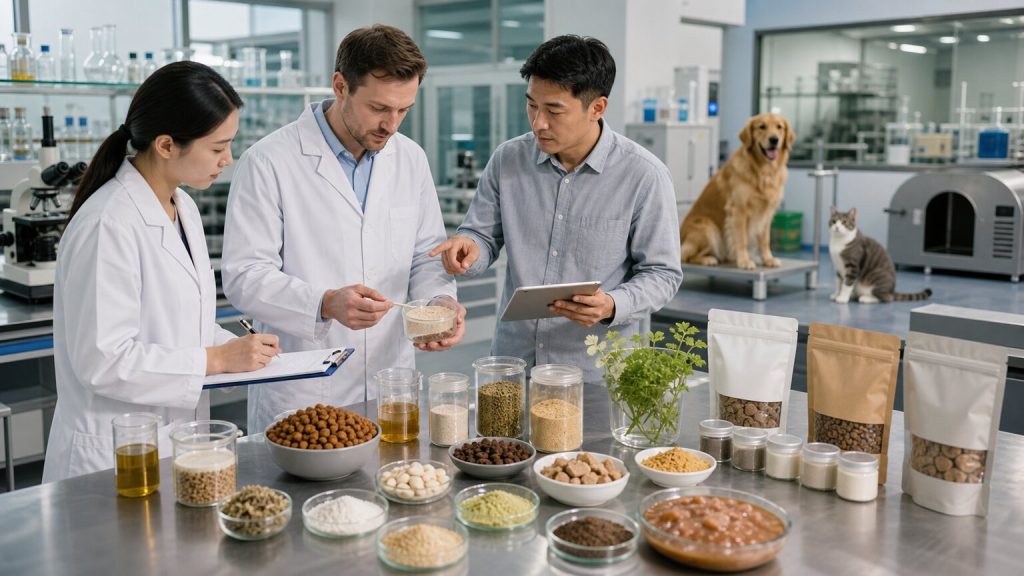
Private-label pet food is one of the categories most likely to benefit from better shared research. Retailers, ecommerce operators, and distributors often want differentiated SKUs but do not have the internal scientific staff of a global pet food company.
That creates a familiar risk. The private-label owner may lean too heavily on the contract manufacturer, while the manufacturer may lean too heavily on existing base formulas. The result can be a product that looks differentiated in packaging but is not deeply differentiated in nutrition, processing, or documentation.
Open research can help private-label teams become better clients. It can help them brief manufacturers more precisely, understand trade-offs earlier, and avoid asking for impossible combinations such as premium nutrition, complex functional claims, tiny batches, very low price, and fast launch timing at the same time.
It also helps buyers evaluate factory capability. A supplier that can explain how research translates into trial batches, palatability testing, nutrient confirmation, shelf-life planning, and label review is in a different position from a supplier that only sells ready-made formulas.
This is the same operating logic behind our article on pet food lighthouse factories and traceability. The future of pet food manufacturing is not only capacity. It is process discipline, records, data, and the ability to prove that a product can be made consistently.
Open Research Still Needs Compliance Discipline
One risk is that open research becomes another marketing shortcut. A brand may read a study, pick one attractive sentence, and turn it into a front-of-pack promise. That is where the category can get into trouble.
In the United States, the FDA’s pet food page explains that animal foods must be safe, produced under sanitary conditions, contain no harmful substances, and be truthfully labeled. FDA also describes ingredient-function expectations and notes that some specific pet food claims are reviewed with supporting data expectations.
For international buyers, the practical lesson is straightforward. Research can support product development, but it does not automatically authorize a claim in every destination market. Labels, nutritional adequacy statements, ingredient names, health-related language, disease-adjacent claims, and functional positioning still need market-by-market review.
Open research should therefore be used as a starting point for stronger product governance, not as a replacement for regulatory work.
The Claims Boundary Will Become More Valuable
The brands that benefit most from open research may not be the loudest marketers. They may be the teams that learn where not to overclaim.
For example, a study may support a hypothesis about an ingredient under specific conditions. It may not support a broad claim across all life stages, all processing formats, all inclusion levels, or all health outcomes. A digestibility result may not equal a clinical claim. A palatability finding may not equal long-term nutrition proof. A promising probiotic or postbiotic may still need viability, stability, dosage, and target-animal context.
That is relevant to categories like gut health and weight support. In our article on pet probiotic supplements moving into life-stage and weight-management SKUs, we noted that category growth creates more need for documentation, SKU discipline, and channel education. Open research can help, but only when it is interpreted carefully.
What Buyers Should Ask Suppliers
For procurement teams and distributors, this trend suggests a more useful supplier conversation.
Ask whether the formula is based on internal research, published research, supplier-provided evidence, or a standard base formula. Ask which parts of the evidence are product-specific and which are general category references. Ask what was tested after processing, not only before processing. Ask whether the product has batch records, palatability data, nutrient confirmation, shelf-life logic, packaging validation, and change-control rules.
For ingredient-heavy formulas, ask what happens if a raw material changes origin, season, supplier, moisture level, fat level, particle size, or microbiological profile. For functional formulas, ask which claims are intended for packaging, which are intended for sales education, and which should remain internal product rationale.
These questions do not turn a buyer into a nutrition scientist. They make the supplier reveal whether it has a serious development process.
What This Means For The Industry
The pet food market is entering a stage where “research-backed” will no longer be enough as a phrase. Buyers, distributors, retailers, and informed consumers will increasingly ask what kind of research, whose research, under what conditions, and how it connects to the finished SKU.
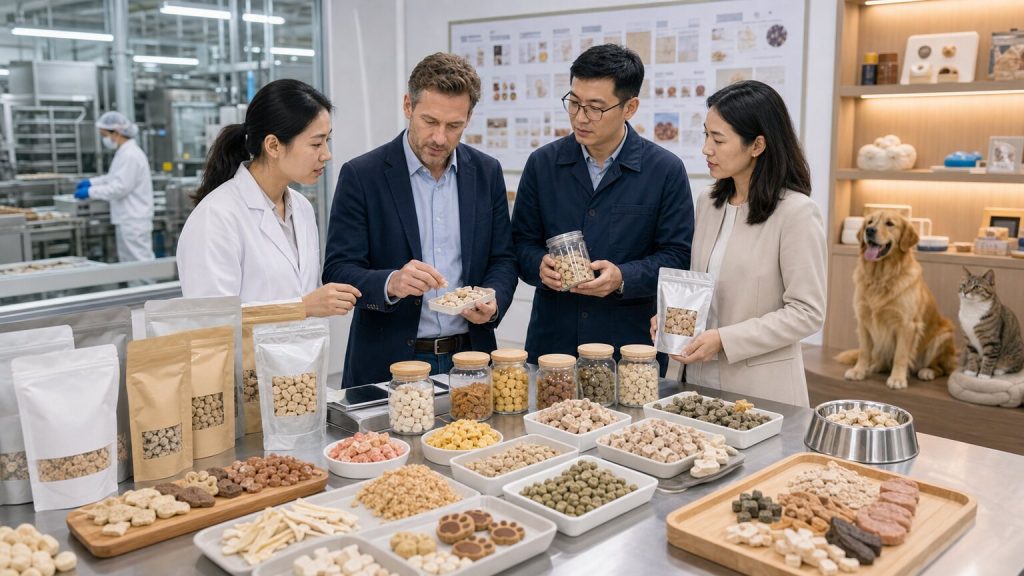
That will create pressure on every part of the chain. Ingredient suppliers need better documentation. Contract manufacturers need clearer trial and scale-up systems. Brand owners need more disciplined claims. Retailers need product education that goes beyond flavor names and packaging design. Investors need to understand the difference between a marketing story and a defensible product platform.
Open pet food research will not remove competition. It may make competition more serious. If the shared knowledge floor rises, brands will need to compete through execution: formulation judgment, sourcing discipline, manufacturing control, palatability, packaging, channel fit, customer trust, and honest communication.
For a broader view of pet industry manufacturing, product development, sourcing, and channel strategy, readers can also follow Pet Industry Insights on Facebook.
Our View
The most important lesson from the Champion Petfoods case is not that every company should open its private R&D. It is that some kinds of research are becoming too important to remain trapped inside isolated teams.
Pet nutrition is a high-trust category. Bad information hurts not only one brand, but the credibility of the market. Better shared research can help smaller brands develop more responsibly, help suppliers sell with evidence, and help buyers separate real capability from polished sales language.
For overseas buyers and industry operators, the practical takeaway is to treat open pet food research as a tool, not a shortcut. Use it to improve briefs, supplier audits, formulation questions, claim discipline, and category strategy. The winners will not be the companies that quote the most research. They will be the companies that can turn sound research into stable, compliant, repeatable, commercially useful products.
References
Chongyejia on Sohu: why a pet food giant is opening research findings to the industry
Mars: Champion Petfoods opens CAD 32 million Global Innovation and Discovery Centre
Champion Petfoods: University of Guelph research collaboration