
For years, many pet product distributors built their business around a straightforward model: secure brand rights, move inventory into pet stores, and make a margin between supply price and wholesale price. That model still exists, but it is becoming less defensible in many markets. Products are easier to find, stores compare brands online, and price competition has reduced the value of simply being the middle layer.
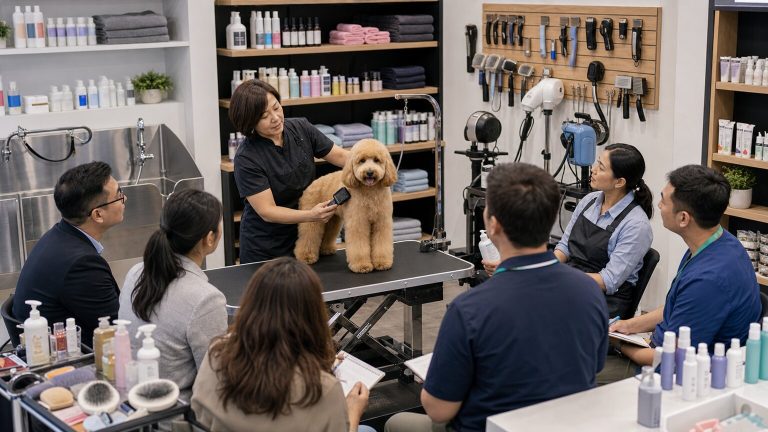
A recent Sohu pet-industry article described a striking response among several regional Chinese pet distributors: they are building grooming classrooms. These are not casual product demos. They are training spaces where pet stores can learn bathing, coat-care, product-use, pricing, and service-upgrade methods, while distributors use education to deepen customer relationships and drive product conversion.
For overseas distributors, wholesalers, grooming-product brands, and pet specialty retailers, the signal is worth studying. Grooming education is not just a training activity. In the right hands, it becomes a channel tool.
Why Distribution Needs A New Value Proposition
The pressure on traditional distribution is easy to understand. When product access was limited, a distributor’s value came from availability, delivery, local relationships, and brand coverage. If a store could not easily discover new products, the distributor was also an information gatekeeper.
That advantage is weaker now. Pet stores can see new brands through social media, ecommerce marketplaces, trade shows, live selling, and competing distributors. Many brands are also more willing to sell across multiple channels. When every distributor can offer similar shampoos, conditioners, brushes, wipes, supplements, treats, and accessories, the store’s loyalty becomes more fragile.
The store’s question changes from “where can I buy this product?” to “who can help me make money with this product?”
That is the real reason grooming classrooms are interesting. They move the distributor from inventory supply into operating support. A shampoo is no longer just a bottle on a shelf. It becomes part of a bathing protocol, a coat-repair service, a skin-comfort conversation, a post-grooming retail recommendation, and a recurring consumables order.
This is similar to the channel logic we discussed in why consumer goods companies are moving into pet retail channels. Control over retail is not only about store count. It is about data, service standards, repeat purchase, and the ability to influence what happens inside the store.
Why Grooming Is A Practical Entry Point
Not every category is suitable for distributor-led education. Grooming is unusually well suited because it combines service revenue, consumable products, visible results, repeat usage, and staff skill.
A pet store can stock shampoo and brushes without much training, but the sales impact may be limited. A store that learns how to create tiered grooming services, select the right coat-care routine, recommend home-care products, and explain visible results can raise the value of the same product set.
That is why grooming education can create a stronger business case than a standard sales promotion. Discounts may move inventory once. Training can change how the store earns money every week.
The Sohu article noted that some distributors are not treating grooming classrooms as immediate profit centers. They spend on facilities, instructors, small-group sessions, and repeated courses. In several examples, the training itself was free or loss-making. The commercial return came later: stronger store loyalty, higher consumables orders, better product adoption, and expansion from back-room grooming products into front-room retail categories.
That logic is not limited to China. In mature markets, grooming education has long been tied to trade shows and professional development. SuperZoo’s education program, for example, includes retail and grooming education, special sessions, and live demonstrations. Barkleigh’s grooming events combine conferences, seminars, competitions, trade-show booths, and grooming-related products. The global pattern is clear: grooming education and product commerce often work best together.
From Product Demo To Store Operating System
The strongest grooming classrooms are not just places where a brand trainer explains a shampoo formula. They function more like a store operating system.
First, they teach technique. This includes bathing sequence, drying control, coat-condition assessment, dematting discipline, ear and paw handling, safety, hygiene, tool selection, and product dosage. When stores understand technique, they use consumables more consistently and waste less product.
Second, they teach service design. A low-margin “basic bath” can become multiple service levels: puppy introduction, senior-pet comfort wash, sensitive-skin bath, seasonal coat reset, deodorizing service, shedding-control package, or premium finish. The goal is not to overcomplicate the menu. It is to give the store enough structure to move beyond one undifferentiated price.
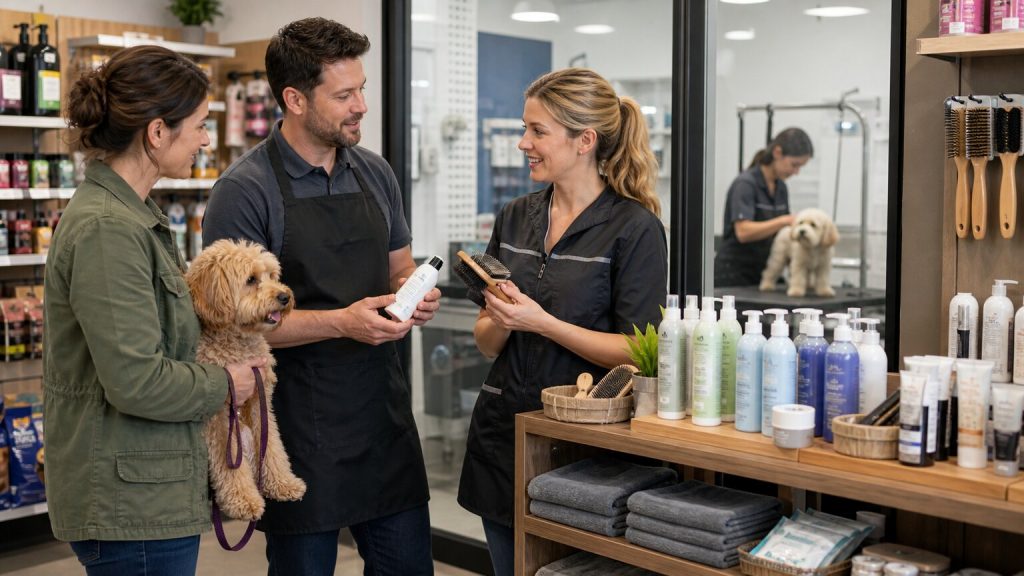
Third, they teach retail attachment. After a grooming session, the customer has just seen the pet’s coat, skin, odor, shedding, or dental condition. This is one of the few moments when product recommendation can feel natural rather than forced. Brushes, coat sprays, wipes, dental-care products, towels, supplements, and skin-support products can be explained as home-care support rather than random add-ons.
That makes grooming education relevant even beyond the grooming room. Our earlier article on home pet grooming tools focused on product-system opportunities for buyers. Distributor-led grooming education adds another layer: the same tools become more valuable when stores know how to demonstrate them, explain them, and connect them to service outcomes.
What Distributors Gain
For distributors, the first benefit is stickiness. A store may switch suppliers for a small price difference if the distributor only delivers cartons. It is harder to switch away from a partner that trains staff, helps improve grooming revenue, designs service packages, and supports product use.
The second benefit is product adoption. Many grooming products fail not because the product is poor, but because the store does not understand when to use it, how much to use, how to explain it, or how to price the service around it. Training reduces that gap.
The third benefit is better feedback. A distributor running classes hears directly from groomers and store owners. Which products rinse poorly? Which fragrances are too strong? Which brushes fail after repeated use? Which towel sizes are awkward? Which coat-care claims are hard to explain? That feedback can improve assortment selection and supplier negotiation.
The fourth benefit is cross-category expansion. Once a distributor becomes trusted in grooming, the relationship can extend into oral care, hygiene, nutrition support, skin-care supplements, towels, dryers, clippers, appointment systems, and store operation tools. This matters because grooming is often the doorway into broader service-led retail.
There is a natural connection here with our analysis of pet oral care as a repeat-purchase category. Grooming appointments can reveal bad breath, plaque concerns, chewing habits, and owner confusion around daily care. A trained store team can connect those observations to appropriate retail education, while still avoiding veterinary diagnosis or unsupported medical claims.
What Pet Stores Gain
For pet stores, the appeal is straightforward. Many stores know they need higher-margin services, but their teams are overloaded. Owners may spend too much time doing basic washing and grooming themselves, leaving little time for retail management, membership programs, visual merchandising, or customer follow-up.
Education can help stores raise service value enough to support better labor allocation. If grooming is priced too low, the owner remains trapped in manual work. If grooming quality, service tiers, and customer communication improve, the store may have more room to hire or retain skilled staff.
A good training program also reduces operational inconsistency. One groomer may use too much product. Another may skip a step. A third may be uncomfortable recommending home-care items. The distributor classroom creates a shared method, which makes service delivery easier to repeat.
For small independent stores, this kind of practical help can be more useful than another discount sheet. The store does not only need cheaper product. It needs a way to turn product into repeatable service income.
What Buyers Should Ask Before Building The Model
Grooming education sounds attractive, but it is not automatically profitable. Overseas distributors and wholesalers should evaluate it carefully before copying the model.
The first question is whether the distributor has enough customer density. A classroom needs recurring attendance. If stores are too spread out, travel and scheduling may make the economics difficult. In that case, regional pop-up workshops, trade-show sessions, or hybrid training may be more practical than a permanent classroom.
The second question is instructor credibility. Store owners and groomers quickly recognize weak training. A distributor cannot build loyalty with shallow product promotion disguised as education. The instructor must understand grooming technique, service pricing, customer communication, and product use.
The third question is curriculum design. A one-time seminar may create excitement, but it rarely changes store behavior. The stronger model is a repeatable curriculum: entry-level technique, advanced coat care, seasonal services, product rotation, customer consultation, retail attachment, and staff onboarding.
The fourth question is measurement. Distributors should track attendance, store repeat orders, product mix changes, service-package adoption, training-to-order conversion, and customer retention. Without measurement, grooming education can become an expensive branding exercise with unclear return.
The fifth question is supplier participation. Grooming brands may be willing to support samples, instructors, demo equipment, or co-funded workshops. But the distributor should avoid turning the classroom into a hard-selling event. If stores feel the session is only a sales pitch, trust erodes.
The Risk: Education Can Become Another Price War
The Sohu article also raised a useful warning. If every distributor starts offering free grooming classes, the format can become crowded. Stores may attend multiple sessions, collect samples, and buy little. Distributors may compete on instructor names, gift packs, venue quality, and event frequency, pushing costs higher without improving outcomes.
This is the education version of a price war. The visible activity increases, but the business value may not.
The better path is to make the classroom outcome-based. Instead of asking how many workshops were held, ask what changed in store behavior. Did stores introduce a better service menu? Did groomers use products correctly? Did retail attachment improve? Did the distributor gain more stable repeat orders? Did the store owner see a clearer business case?
That is where distributors can build a real moat. Anyone can rent a room and invite a speaker. Fewer companies can create a training system that helps stores make more money and then converts that value into durable channel relationships.
How This Could Evolve
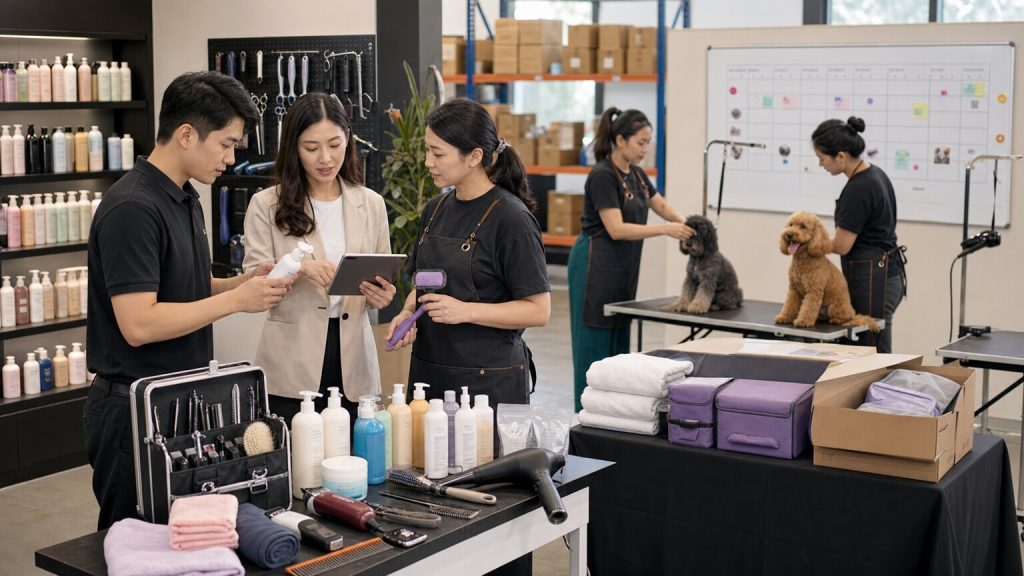
Grooming classrooms may be only the first version of a broader channel shift. Once a distributor builds education capability, the same infrastructure can support other store operating needs.
A distributor could train stores on membership design, seasonal merchandising, appointment follow-up, post-grooming retail scripts, hygiene protocols, staff onboarding, category displays, live-stream product education, or private-label service bundles. The physical classroom becomes a business-development hub.
For grooming-product suppliers, this changes the way distributors should be evaluated. The best distributor may not be the one with the largest warehouse or the lowest price. It may be the one that can teach stores how to use the product, price the service, tell the story, and reorder reliably.
For overseas buyers, the lesson is practical. When evaluating grooming, hygiene, and service-adjacent product lines, do not only ask about margin and MOQ. Ask how the product will be taught, demonstrated, bundled, and supported at store level.
The pet industry is moving from broad growth to more disciplined operation. In that environment, distributors that only move boxes will face pressure. Distributors that help stores improve service quality, customer retention, and repeat purchase can become much harder to replace.
Grooming education is not a side project. Done well, it is a channel strategy.