
Pet pharmacies are becoming more than a niche service attached to veterinary clinics. In several markets, they are developing into a distinct retail channel that sits between veterinary care, OTC pet health products, ecommerce, and professional product guidance.
A recent Chongyejia report on Sohu noted that Nanjing Pharmaceutical’s first professional pet pharmacy, Abeibei Pet Pharmacy, had entered trial operation. The report described a model built around pharmaceutical supply-chain capability, qualification review, product traceability, prescription assessment, and one-to-one medication guidance. It also noted that other Chinese pharmacy and healthcare retail groups have been testing pet-related formats, including store-within-store models, independent pet pharmacies, and online consultation plus product delivery.
For overseas buyers, distributors, and pet health brands, the important point is not one store opening in China. The signal is broader: pet health retail is becoming more professional, more channel-specific, and more sensitive to compliance. This affects veterinary OTC products, supplements, medicated shampoos, ear and skin care, dental products, recovery items, parasite-control adjacent products, prescription-adjacent categories, and specialized nutrition.
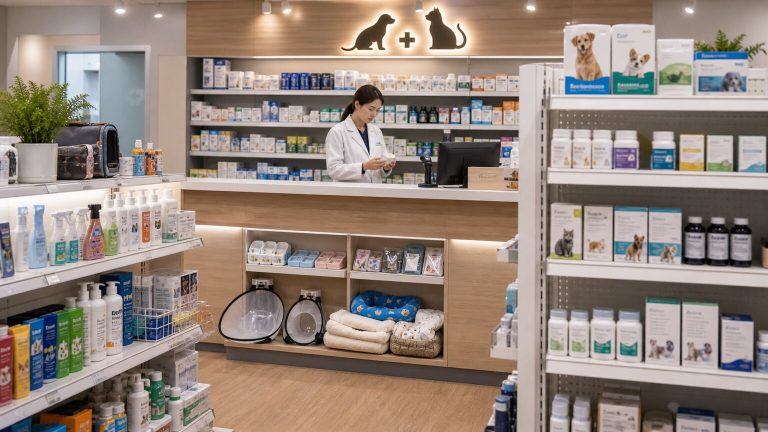
Why pet pharmacies matter as a channel
Most pet product categories are sold through familiar routes: pet specialty stores, ecommerce platforms, grocery, mass retail, veterinary clinics, grooming salons, and distributors. Pet pharmacies add another layer.
They are not just pet shops with health products. A true pet pharmacy format tries to borrow parts of the human pharmacy model: controlled sourcing, product qualification checks, batch traceability, staff guidance, prescription handling where legally permitted, and stronger separation between ordinary wellness products and regulated medicine.
That matters because pet health products carry a different level of trust risk. A toy can break and create complaints. A bag of litter can dust. A feeder can leak. But a product positioned around health, treatment, prevention, recovery, or medication can create regulatory, veterinary, and reputational problems if claims, labeling, storage, or customer guidance are wrong.
This is where the channel becomes valuable for suppliers that are serious about quality. A professional pet pharmacy can give credible products a better context than a crowded general marketplace listing. It can also filter out weak products that rely on vague claims, unsupported ingredients, or poor documentation.
The product boundary is the first buyer question
Pet pharmacies force buyers to define product boundaries more carefully.
In the U.S., FDA explains that animal drugs can fall into different legal marketing statuses, including prescription, veterinary feed directive, and over-the-counter categories. The exact rules vary by country, but the business lesson travels well: a pet product cannot be treated the same way just because it sits on a retail shelf.
A distributor evaluating a pet pharmacy channel should separate at least four lanes.
The first lane is regulated veterinary medicine, including products that require a veterinarian’s prescription or professional oversight in the target market. The second lane is OTC animal health products that can be sold without a prescription but still require proper labeling, storage, and approved claims. The third lane is health-adjacent products, such as supplements, dental care, ear cleaners, skin care, calming products, joint products, probiotic products, recovery collars, wound-care accessories, pill organizers, and medicated grooming items. The fourth lane is professional service support: pharmacist or veterinary review, consultation, refill reminders, after-sale education, and adverse-event handling.
Buyers should not blur these lanes for faster sales. Blurred positioning can create short-term conversion but long-term channel risk.
Why this is not the same as the pet supplement aisle
Pet supplement and wellness products are already common in ecommerce and specialty retail. Pet pharmacies can still be different because the purchase context changes.
In a general ecommerce listing, the consumer may compare price, reviews, ingredients, and delivery speed. In a pharmacy-style channel, the consumer or pet-care professional may expect a higher level of product explanation: what the product is, what it is not, whether it needs veterinary advice, how it should be stored, what claims are supported, and when the product is inappropriate.
That creates opportunity for better suppliers. A joint supplement with credible ingredient documentation, lot traceability, conservative claim language, and clear dosage guidance can compete differently from a generic wellness bottle. An ear cleaner with clear use instructions, safety warnings, batch control, and channel training can be easier for professional retailers to support. A recovery product or medicated shampoo can be positioned around practical care routines instead of lifestyle marketing.
This also connects to our earlier analysis of pet oral care products. Health-adjacent categories can look like ordinary retail goods, but buyer confidence depends on evidence language, instructions, claims, packaging, and whether the product can be explained responsibly.
Supply chain capability becomes part of the value proposition
The Sohu report emphasized supply-chain quality control and traceability as part of the Nanjing Pharmaceutical pet pharmacy story. That point is important beyond China.
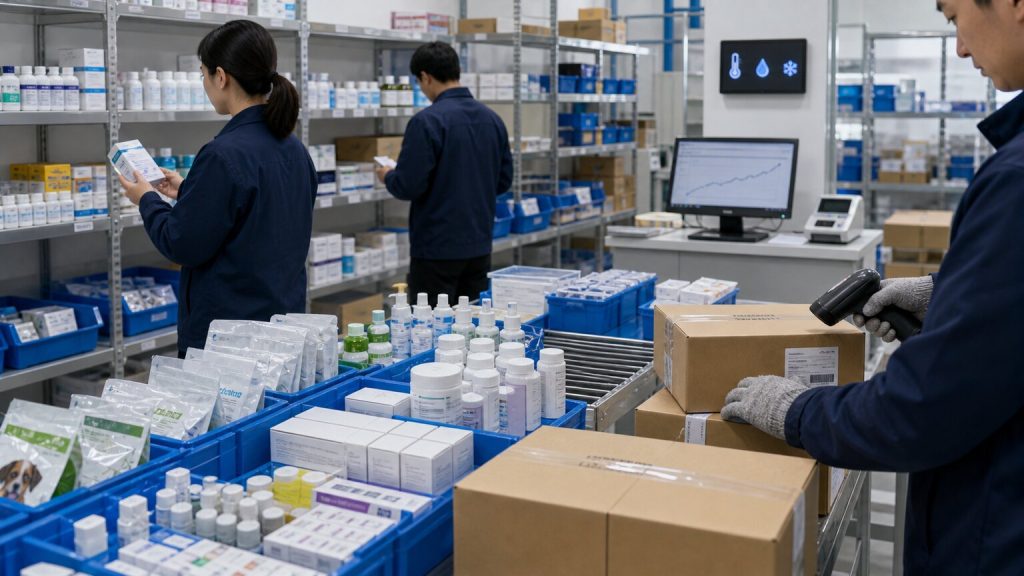
Health products need stronger distribution discipline than many low-risk accessories. Buyers should ask whether the supplier and distributor can maintain batch records, expiration management, recall procedures, storage conditions, documentation, barcode accuracy, and channel-level product training. For products with temperature sensitivity, active ingredients, liquid formulas, or strict shelf-life requirements, the logistics system matters as much as the product design.
Pet pharmacies are also likely to care about qualification files. Product registration status, ingredient documents, manufacturing certificates, test reports, safety data, label approvals, and import documents may be requested before listing. A supplier that cannot provide these quickly may be unsuitable for the channel, even if the product sells well online.
This is a different sales motion from many pet accessory categories. In low-ticket pet accessories, success often depends on ad economics, bundle logic, and margin per click. In pet pharmacy, the channel asks a harder question: can the product survive professional review?

What buyers should ask before entering the channel
A buyer considering pet pharmacy distribution should start with a risk review, not a product catalog.
What is the legal classification in the target market? Is the product a drug, supplement, cosmetic, hygiene product, device, food, feed additive, or accessory? Are claims supported? Does the product imply treatment, prevention, diagnosis, or cure? Does it require veterinary involvement? Are labels compliant in the selling market? Are instructions clear enough for store staff and ecommerce customer service?
The next layer is operational. Does the supplier support batch traceability? Are expiration dates printed and managed correctly? Is the packaging tamper-evident where needed? Can the product survive shipping and storage? Is there a complaint and adverse-event process? Can the distributor provide training sheets, FAQ materials, and responsible product descriptions?
The third layer is channel fit. Some products belong in a veterinary clinic. Some belong in ecommerce. Some can work in a pharmacy-style retail setting. Some should be sold only with professional consultation. Buyers need to map the product to the channel instead of assuming that every health item belongs everywhere.
Online plus offline may be the stronger model
The pet pharmacy format is unlikely to be purely offline. The Sohu report mentioned signs of online platform operation in the Abeibei model. That fits a broader retail pattern: health products often need both professional trust and convenient replenishment.
An offline location can build credibility, handle urgent needs, support consultation, and provide professional product explanation. Online channels can handle refill behavior, regional coverage, after-hours demand, content education, and long-tail SKU availability. For distributors, the combined model creates more complex requirements: inventory synchronization, prescription or consultation workflow where applicable, customer records, delivery timing, and controlled product information.
This is where pet pharmacy has a different logic from ordinary pet retail. A customer buying a leash may simply choose color and size. A customer buying ear care, parasite-control adjacent items, supplements, or medication-related accessories may need guidance, reminders, and confidence that the product source is legitimate.
For brands, this means educational content is not optional. Product pages, packaging, staff scripts, quick-reference guides, and channel training should be planned before launch.
Pet pharmacies may reshape health product merchandising
If pet pharmacies grow, they may change how pet health products are merchandised.
Instead of grouping products only by format, pharmacies may group them by care scenario: skin and coat, ear care, dental care, digestive support, joint and mobility, senior care, recovery, parasite-control support, chronic-condition support, medication administration, and veterinary nutrition. That makes the shelf more useful for staff and customers, but it also raises the bar for claim discipline.
Senior-care products are a good example. Our article on dog longevity drugs and the pet health market discussed how the aging-pet segment is attracting more scientific and commercial attention. Pet pharmacies could become one of the channels where senior wellness, chronic-condition support, and medication-administration products are organized more professionally. But the line between wellness support and medical claim must be handled carefully.
For buyers, the merchandising question is not “how many SKUs can we place?” It is “which care scenarios can we support responsibly?”
What suppliers need to prepare
Suppliers that want to enter pet pharmacy channels should prepare a stronger data package than they would for ordinary retail.
At minimum, buyers may expect ingredient or material documentation, product specifications, label files, claim rationale, shelf-life data, batch control, manufacturing information, quality certificates, safety warnings, use instructions, storage requirements, complaint handling process, and market-specific compliance review. For imported products, documentation needs to match the target country’s import and labeling rules.
Packaging should also be redesigned for professional trust. It should avoid exaggerated cure language, unclear dosing, vague “vet recommended” statements, and unsupported functional claims. It should clearly identify the species, use case, net contents, ingredients or materials, instructions, warnings, storage, manufacturer or responsible party, batch, and expiration where relevant.
Suppliers should also expect channel training requests. Pharmacy staff and distributors may need short training sheets explaining product positioning, restrictions, FAQs, and when to recommend veterinary consultation.
Risks for buyers and distributors
The biggest risk is treating the pet pharmacy channel as a simple sales extension.
A distributor that lists weakly documented products may face returns, retailer rejection, regulatory questions, or brand damage. A brand that uses aggressive claims may get short-term attention but lose access to professional channels. A retailer that mixes prescription products, OTC products, supplements, and ordinary care items without clear processes may confuse customers and create liability.
There is also channel conflict. Veterinary clinics may be sensitive to pharmacy-style retail if they believe it bypasses professional care. Ecommerce platforms may push price competition. Pharmacies may demand documentation and training that suppliers are not ready to provide. These tensions are manageable, but only if the channel role is clear.
The better model is complementary. Pet pharmacies can support legitimate product access, refill convenience, qualified guidance, and traceable supply. They should not replace veterinary diagnosis or turn medical categories into casual impulse purchases.
Our view
Pet pharmacies are creating a new retail channel for pet health products. The strongest opportunity is not simply selling more medicine. It is building a more trustworthy commercial layer for OTC care, health-adjacent products, specialized nutrition, medication-support accessories, and responsible replenishment.
For overseas buyers and distributors, this channel rewards discipline. Product classification, claim control, batch traceability, label review, supplier documentation, storage, training, and after-sale support all matter. The category is attractive because pet healthcare spending is growing, but the channel will not tolerate the same loose standards that sometimes pass in general ecommerce.
Our view is that pet pharmacy will become a useful test of pet health product seriousness. Brands that can support professional review may gain stronger trust and better channel positioning. Brands that rely only on trendy wellness language may struggle as retail moves closer to regulated healthcare logic.
References
Chongyejia on Sohu: Nanjing Pharmaceutical’s pet pharmacy channel signal
FDA: regulation of animal drugs
AVMA: prescriptions and pharmacies FAQ
International Trade Administration: China pet products market intelligence