
Pet waste bags look like one of the simplest products in the pet aisle. A roll of bags, a leash dispenser, a small clip, maybe a refill box. But the category is more complex than it appears.
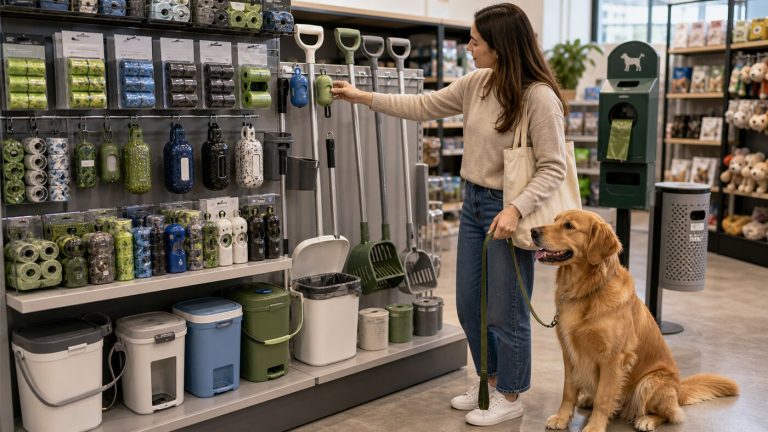
Pet waste management products sit between public-space responsibility, hygiene, walking routines, odor control, environmental claims, and repeat consumables. They include waste bags, roll refills, leash-mounted dispensers, long-handle scoopers, cat litter disposal accessories, odor-control pails, refill cartridges, wipes, and park-style cleanup stations.
For global buyers and distributors, this is a category where small product failures become visible quickly. A bag tears. A perforation fails. A dispenser falls off the leash. A pail leaks odor. A “biodegradable” claim is challenged. A refill roll does not fit the installed dispenser. The product may be low-ticket, but the operational detail is not low-risk.
Why pet waste products deserve more attention
Pet waste is not only a household nuisance. The U.S. Environmental Protection Agency notes in its stormwater pet waste management materials that pet waste left on the ground can be picked up by stormwater and carried into streams, lakes, and rivers, where it can affect people, animals, and ecosystems. The CDC also advises pet owners to pick up dog poop and dispose of it properly because dog and cat feces can contain parasites and germs harmful to people.
Those points create the foundation for a real product category. Waste bags and cleanup tools make responsible behavior easier. They support daily dog walking, apartment living, dog parks, hotels, grooming facilities, veterinary clinics, pet-friendly retail, and community waste stations.
The demand is also recurring. Unlike a carrier or bowl, waste bags are consumed. That can make the category attractive for retailers, subscription programs, private-label packs, and walking accessory bundles. But repeat purchase depends on reliability. Consumers forgive very little when a cleanup product fails during actual use.
The category is broader than a roll of bags
The basic bag roll remains the center of the category, but buyers should map the system around use occasions.
Leash walks require compact rolls, secure dispensers, smooth perforations, bag opening ease, and clip durability. Dog parks and apartment communities may need larger rolls, refill stations, signage, and trash-flow compatibility. Home cleanup can involve long-handle scoopers, larger bags, yard waste tools, and odor-control pails. Cat households may use litter disposal pails, odor-control liners, scoops, and sealed refill systems.
Retailers can also build category baskets. A walking kit might include bags, a dispenser, a leash clip, wipes, and a small travel pouch. An apartment dog-owner kit might include bags, odor-control pail liners, and cleaning wipes. A dog park or B2B facility kit might include station bags, signage, and bulk cartons.
The key is not to sell every format. It is to match the format to the cleanup routine.
Environmental claims are a serious risk area
This category is heavily exposed to environmental language: biodegradable, compostable, plant-based, recycled content, ocean-bound plastic, plastic-free, eco-friendly, earth-friendly, and green. These claims can improve shelf appeal, but they can also create legal and trust risk.
The FTC’s Green Guides are designed to help marketers avoid misleading environmental claims. FTC consumer guidance says green claims must be truthful, and the Green Guides explain how businesses should approach environmental marketing. The FTC’s Environmental Claims Summary also notes that compostable claims should be qualified when home or municipal composting is not available or not suitable in a timely way.
For pet waste bags, this matters because the bag’s material is only part of the story. Where will the used bag go? A landfill? A municipal compost facility? Household compost? A trash bin in a park? Is the facility available to the consumer? Is pet waste accepted? Does the claim apply to the bag, packaging, or both?
Buyers should not approve “eco” packaging just because competitors use similar words. Claims should be tied to material documentation, test standards where relevant, facility availability, disposal instructions, and the market where the product is sold.
This is similar to the broader compliance point in our article on EU GPSR and pet product compliance: traceability, instructions, safety information, and market-facing language need to be planned before production, not patched after shipment.
Bag performance is the core trust test
A pet waste bag has a simple job, but that job is unforgiving.
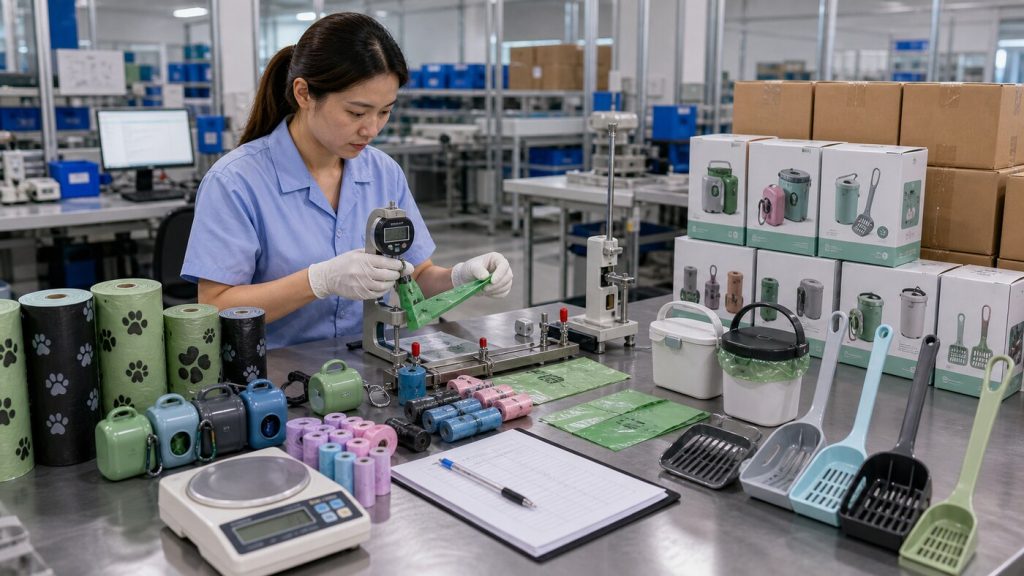
Buyers should test thickness, puncture resistance, seam strength, odor barrier, opening ease, roll winding, perforation consistency, and dispenser fit. The best product is not always the thickest bag. It is the bag that balances strength, hand feel, cost, roll count, packaging size, and claim discipline.
Perforation quality deserves special attention. Consumers expect one bag to tear cleanly from the roll with one hand, often while holding a leash. If the perforation is too weak, bags separate inside the dispenser. If it is too strong, the roll becomes frustrating.
Opening ease is another review driver. Some bags are strong but hard to open, especially in cold weather or when the user’s hands are dry. Friction, texture, embossing, and material stiffness all affect the experience.
For scented bags, buyers should also test fragrance intensity and market fit. Scent can help shelf differentiation, but it can also trigger complaints if too strong or artificial. Unscented options may be better for some channels.

Dispensers and hardware can decide repeat purchase
Many buyers focus on the bag and treat the dispenser as a free accessory. That can be a mistake.
A weak dispenser can make the whole product feel cheap. Clips break, caps fall off, rolls jam, elastic straps loosen, and bag ends disappear inside the case. If a private-label pack includes a dispenser, the hardware should be tested like a real product, not treated as packaging.
The same applies to scoopers and pails. Long-handle scoopers need hinge strength, jaw alignment, handle stiffness, and cleaning access. Odor-control pails need lid fit, liner compatibility, refill availability, foot-pedal durability, and odor performance. Refill systems need predictable SKU compatibility, otherwise consumers may abandon the product after the first cartridge.
This is where pet waste products resemble pet food storage and feeding hygiene products. Both categories look simple, but trust depends on small repeated-use details: seals, lids, clips, edges, liners, cleaning, and whether the product works every day.
Packaging and count accuracy matter
Pet waste bags are price-sensitive, but packaging still matters.
Consumers compare roll count, bag count, bag size, thickness, scent, material claims, and dispenser compatibility. Retailers compare cube efficiency, shelf visibility, carton strength, and whether multipacks are easy to merchandise. Ecommerce operators also care about crush resistance, weight, and leak-free packaging for scented products.
Count accuracy is a QC issue. A 120-count box should not ship with inconsistent roll counts. Bag dimensions should match the label. Refill rolls should fit common dispenser sizes if that is claimed. Cartons should protect rolls from deformation during transit.
If the product uses environmental claims, packaging needs even more precision. It should identify what the claim applies to: bag, roll core, retail box, dispenser, or shipping carton. Vague green language can create more risk than value.
QC should reflect real walking conditions
Testing should mimic the way people actually use the product.
For bags, buyers should test one-handed roll tear, bag opening, seam pull, puncture resistance, cold-weather handling, wet-hand grip, odor containment, and dispenser feed. For dispensers, test clip retention, cap closure, roll rotation, drop resistance, and attachment to different leash widths.
For scoopers, test handle flex, jaw closure, spring or hinge cycle life, cleaning, and storage. For pails, test lid seal, liner fit, refill installation, odor-control claims, foot pedal cycles, and cleaning access.
For “compostable” or “biodegradable” lines, buyers should request supplier documentation and review whether the claim language is appropriate for the target market. A product can be technically different from conventional plastic and still be marketed poorly.
Channel strategy should follow use frequency
Pet waste products can work in several channels.
Pet specialty retail can build the category around walking essentials, new dog owner kits, apartment living, and odor control. Ecommerce can sell refill packs, bulk boxes, subscription bundles, and dispenser systems. Grocery and mass retail often favor straightforward value packs. Groomers, daycares, dog parks, apartment communities, and pet-friendly hospitality operators may need B2B cartons and station refills.
The strongest channel strategy separates consumer packs from facility packs. A beautiful retail box may not be right for a dog park station. A bulk facility roll may not be right for a premium walking kit.
The low-ticket economics also matter. In our article on low-ticket pet accessories and ad economics, we noted that unit price alone is not the business model. Pet waste bags prove the point: repeat purchase, refill compatibility, shipping cube, margin per box, and customer trust determine whether the category works.
Buyer questions before scaling
Before ordering at scale, buyers should ask:
What bag material is used, and what claim is attached to it? What test data supports environmental language? Does the bag tear cleanly from the roll? Is it easy to open? Does it fit the dispenser? Are roll counts accurate? Does the retail package survive shipping? Does the dispenser clip last? Do refill rolls remain compatible across future production batches?
For pails and scoopers, buyers should ask about lid seal, hinge strength, cleaning access, refill dependency, replacement parts, and packaging volume. For B2B station products, buyers should ask about installation, vandal resistance, bulk carton handling, and compatibility with municipal or property-management workflows.
The goal is to avoid treating the category as disposable just because the bag is disposable.
Our view
Pet waste bags and disposal products are becoming a compliance-sensitive consumables category. The demand is steady, the use case is frequent, and the product is closely tied to public-space responsibility and household hygiene. But the category also carries environmental-claim risk, small hardware failure points, and review-sensitive user experience.
For global buyers, the strongest opportunities are reliable basics: bags that open and tear correctly, dispensers that do not fail, refill systems that remain compatible, pails that control odor realistically, and packaging claims that can be supported.
Our view is that the winners in this category will not be the brands with the loudest “eco” language. They will be the buyers and suppliers who combine responsible claim discipline with practical product reliability.
References
EPA stormwater best management practice: pet waste management