
Pet food manufacturing is moving into a different competitive phase. For many years, the visible part of the category was brand, formula, packaging, flavor, claim language, and retail channel. The less visible part was the factory system behind those products: ingredient control, extrusion stability, food safety, batch traceability, line changeovers, warehouse flow, and quality response.
That back end is becoming more important for buyers.
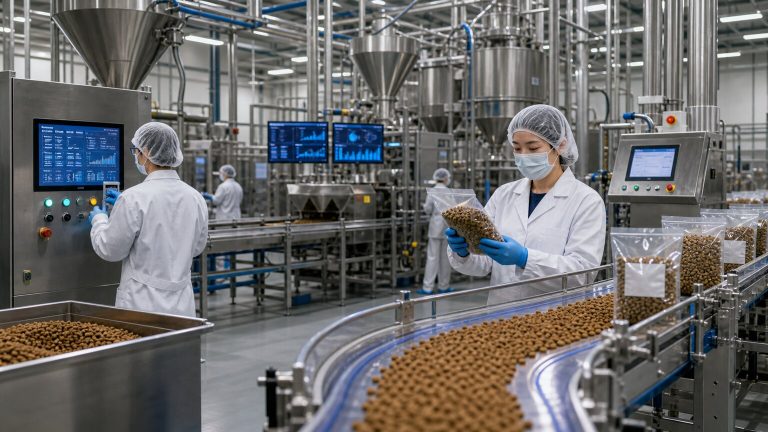
In June 2026, the World Economic Forum announced a new Global Lighthouse Network cohort, with Royal Canin’s Shanghai site listed in the customer-centricity category. A WEF-distributed announcement, republished by Mirage News, said the site needed to deliver more than 400 SKUs while maintaining quality and agility, and that it deployed more than 40 advanced solutions across agricultural sourcing, production, and after-sales care. The same announcement reported customer satisfaction up 20%, in-line defects down 70%, and service levels above 98%.
For overseas buyers, importers, private-label brands, and supplier audit teams, the important point is not the award itself. The signal is that pet food factories are being judged less like simple production sites and more like connected operating systems.
Why this matters beyond one factory
Pet food is a high-trust category. Buyers cannot evaluate it only by looking at the final bag. A strong finished product may depend on ingredient sourcing, supplier qualification, moisture control, extrusion parameters, palatability management, packaging integrity, microbiological controls, warehouse conditions, and recall readiness.
The FDA states that pet food is regulated similarly to other animal foods and must be safe to eat, produced under sanitary conditions, contain no harmful substances, and be truthfully labeled. That is the baseline. But the commercial standard is moving higher, especially for brands that sell across multiple channels and markets.
A lighthouse-style factory matters because it shows where the bar is moving. Buyers are not only asking whether a factory can make a formula. They are asking whether the factory can manage complexity, document quality, change production efficiently, trace product rapidly, and respond when the market changes.
This shift is especially relevant to the category upgrades we covered in China pet supplies market category upgrades. As pet markets mature, product demand becomes more segmented. That segmentation eventually lands inside factories.
The 400-SKU problem
The WEF summary pointed to one of the key manufacturing challenges: personalized, nutrition-based pet care can require hundreds of SKUs.
For a pet food buyer, that complexity is not theoretical. A modern product matrix may include species, breed size, life stage, health positioning, protein source, texture, kibble size, pack size, channel-specific packaging, trial packs, and market-specific labels. A factory that handles only a narrow line may struggle when buyers need frequent changeovers, small-batch launches, or market-specific SKUs.
The risk is that complexity quietly damages quality. Changeovers can increase contamination risk. More SKUs can create label or packaging errors. Small batches can raise cost. More ingredients can make supplier management harder. More claims can create documentation pressure.
This is why buyers should look beyond capacity. A plant that claims high output may still be a poor fit if it cannot handle SKU complexity with stable quality. A factory that can run many SKUs with clean controls, documented changeovers, and reliable traceability is much more valuable.
Digital manufacturing should be tied to business outcomes
Digital factory language is easy to overuse. AI, dashboards, automation, digital twins, smart sensors, control towers, and predictive analytics can sound impressive without changing the actual buyer experience.
The more useful question is simple: what operating problem does the technology solve?
In pet food, valuable digital systems usually connect to one of five outcomes. They reduce defects. They improve traceability. They stabilize product quality. They increase scheduling agility. They make quality response faster. If the technology does not improve at least one of those outcomes, buyers should treat it as a showroom feature rather than a sourcing advantage.
The WEF-reported Royal Canin data is useful because it links technology to measurable outcomes: defect reduction, customer satisfaction, service levels, SKU complexity, and end-to-end deployment from sourcing to after-sales. That is the type of evidence buyers should request from suppliers. A factory does not need a lighthouse award, but it should be able to show how its systems improve real production control.
Quality testing is not separate from production
Strong pet food factories do not treat quality control as a final inspection step.
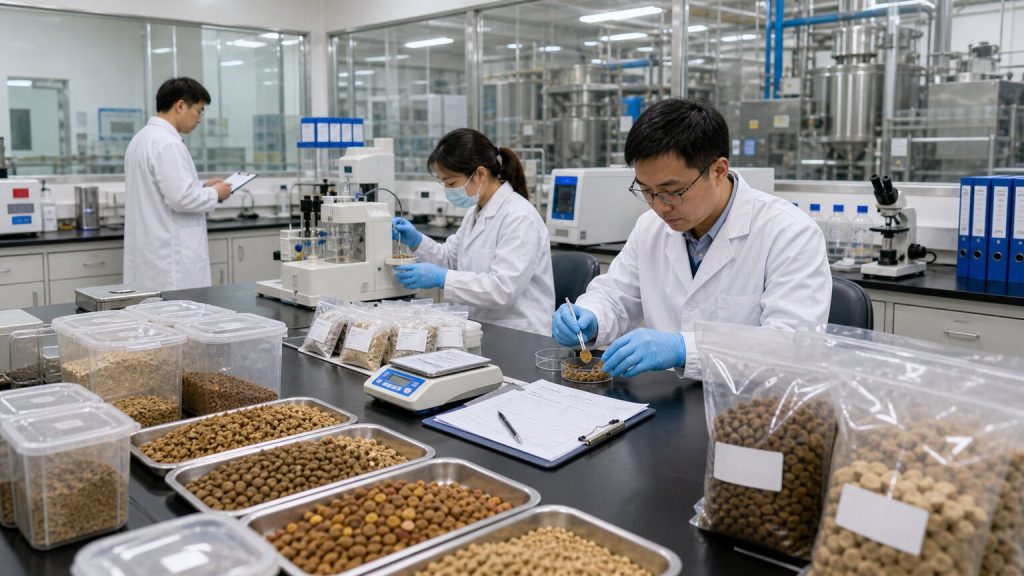
Testing should begin before raw materials enter production. Buyers should ask how the factory qualifies ingredient suppliers, tests incoming materials, manages rejected batches, monitors moisture, checks nutrient consistency, controls foreign matter, and prevents cross-contamination. For premium or functional formulas, documentation becomes even more important because claim credibility depends on consistent inputs and finished-product verification.
The Sohu coverage of Royal Canin’s Shanghai factory emphasized supplier audits, batch-by-batch raw material testing, laboratory testing across safety, nutrition, freshness, and physical performance, and strict control of people flow, material flow, and air flow. Those details matter because quality is built through daily systems, not only through final certificates.
This also connects to our article on pet food storage and feeding hygiene products. Hygiene risk does not end at the factory door. Packaging integrity, storage stability, warehouse conditions, and consumer handling all matter. But the factory is where many of the most important controls begin.
Traceability is becoming a buyer requirement
Traceability used to be discussed mainly after a problem. That is changing. Buyers now want to know whether traceability is built into the production system before a problem occurs.
The Sohu source reported that a Mars Pulse-supported system could complete product quality traceability within one hour, identifying batch and production-line information. Whether buyers are evaluating a global brand factory or a smaller private-label supplier, the underlying question is the same: if a complaint, contamination question, packaging error, or recall concern appears, how quickly can the supplier trace the affected batch?
Good traceability should connect supplier lots, raw material receipt, production batch, line, date, quality tests, packaging batch, warehouse movement, shipment, and customer destination. It should also be practical. A supplier may claim traceability but rely on disconnected spreadsheets that become slow during a real incident.
For importers and distributors, this is not only a factory issue. Traceability must continue into the commercial chain. If the distributor cannot map finished goods to customer shipments, the factory’s traceability system loses much of its value.
What buyers should ask during supplier audits
Buyers should translate lighthouse-factory signals into practical audit questions.
How many SKUs can the factory manage without raising quality risk? How are line changeovers documented? What prevents label and packaging mismatch? How are ingredient lots connected to finished batches? What quality tests are performed on incoming materials, in-process product, and finished goods? What is the factory’s defect trend over time? How quickly can it trace a complaint back to a production batch?
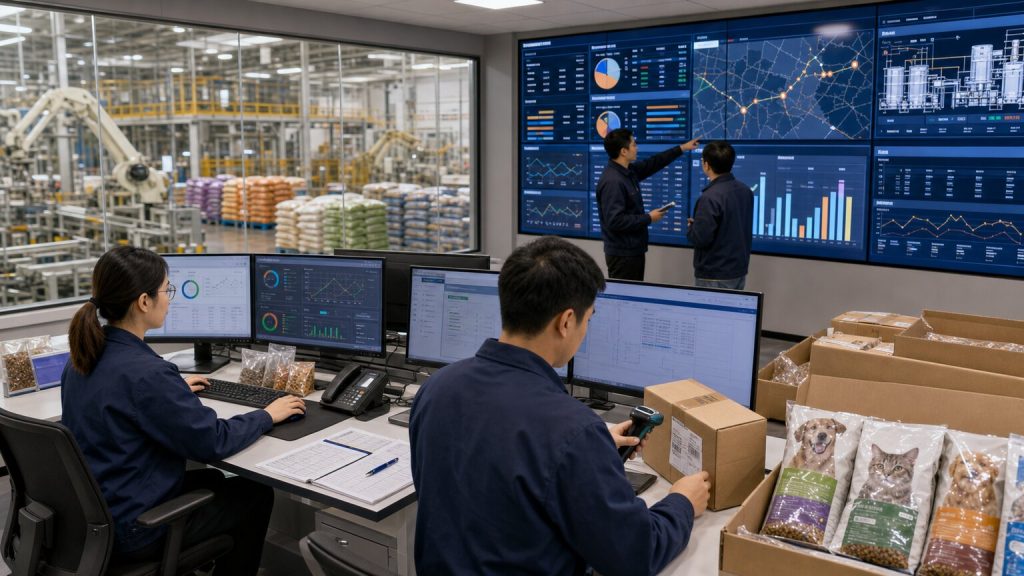
Buyers should also ask about system integration. Are sourcing, production, QC, warehouse, and after-sales systems connected? Is data entered manually or captured automatically? Are quality holds visible to production and logistics teams? Are customer complaints fed back into manufacturing review? Does the factory track service levels, late orders, rework, waste, and complaint rates?
These questions help separate real manufacturing capability from general claims about “smart factory” investment.
Private-label brands should be especially cautious
Private-label pet food buyers often focus on formula, MOQ, lead time, packaging, and price. Those are important, but they are not enough.
If a supplier is producing multiple brands, multiple formulas, and multiple packaging languages, complexity risk increases. A small packaging mistake can create regulatory problems. A formula change that is not documented properly can damage trust. A rushed production slot can create quality inconsistency. A supplier with weak traceability can turn a limited issue into a broad commercial crisis.
Private-label buyers should therefore ask for process evidence: batch records, retention sample policy, changeover procedures, sanitation records, raw material inspection methods, label control, shelf-life validation, complaint history, and recall mock-test results. Where possible, buyers should visit the site or commission a specialist audit.
The goal is not to demand that every supplier looks like a multinational lighthouse factory. The goal is to use that benchmark to ask sharper questions.
The supplier ecosystem matters
A digitally advanced pet food plant still depends on suppliers. Meat meals, grains, vitamins, minerals, oils, palatants, packaging films, bags, cartons, labels, and logistics providers all affect finished product quality.
A factory that brings quality control upstream has an advantage. Supplier audits, raw material risk scoring, weather or crop risk monitoring, inbound testing, packaging validation, and ESG-related supplier criteria can reduce surprises before they reach the production line.
This is one reason the WEF-reported Royal Canin example is relevant to the wider industry. The announcement described advanced solutions across agricultural sourcing, production, and after-sales care, not only inside the factory wall. That full-chain view is increasingly important for buyers that need stable supply across volatile ingredient markets.
For buyers working with pet health-adjacent channels, the point is even stronger. As discussed in our article on pet pharmacies and pet health retail, professional channels are less tolerant of weak documentation. Pet food suppliers serving veterinary, pharmacy-style, or premium channels will need stronger manufacturing evidence.
What this means for distributors
Distributors often sit between factory claims and retailer expectations. A lighthouse-style benchmark gives distributors a clearer way to evaluate risk.
For premium pet food brands, distributors can ask for more than marketing materials. They can request manufacturing capability summaries, food safety certifications, traceability procedures, SKU complexity management, service-level data, and quality response workflows. For private-label programs, distributors can use the same framework to compare factories that may otherwise look similar on price.
Distributors should also consider how factory capability affects channel promise. If a brand promises frequent innovation, personalized nutrition, or specialized formulas, the factory must support that complexity. If a distributor promises reliable replenishment, the factory must support service levels and production planning. If a retailer expects fast complaint resolution, traceability must be strong.
The factory is not invisible anymore. It is part of the commercial proposition.
Our view
A pet food lighthouse factory is not just an award story. It is a signal that manufacturing capability is becoming a visible competitive factor in the pet food industry.
For buyers, the lesson is practical. Do not judge pet food suppliers only by formula samples, packaging, price, and sales pitch. Ask how the factory manages SKU complexity, incoming materials, changeovers, in-process control, defect trends, traceability, complaint response, and supplier quality. Ask what the technology actually improves.
Our view is that pet food sourcing will increasingly reward suppliers that can prove operational discipline. The strongest factories will not simply make more pet food. They will make complex pet food more consistently, document it more clearly, trace it faster, and help buyers carry less risk.
References
Mirage News republishing World Economic Forum Global Lighthouse Network 2026 announcement
Chongyejia on Sohu: Royal Canin Shanghai factory and pet food lighthouse manufacturing
Chongyejia on Sohu: global pet industry’s first lighthouse factory signal