
Pet travel products are often merchandised like convenience accessories: a soft carrier for a small dog, a crate for a cat, a water bowl for the car, a harness for a weekend trip. But the category is becoming more serious than that.
As more owners take pets into cars, hotels, trains, short flights, outdoor trips, and urban daily routines, travel products now sit at the intersection of comfort, restraint, rules, safety, and buyer liability. A carrier is not only a bag. A crate is not only a plastic box. A car tether is not only a strap. Each product has to work under movement, stress, cleaning, ventilation, size constraints, and consumer misunderstanding.
For global buyers, this makes pet travel gear a category where the product brief must be more precise than the shelf label.
Why travel gear is moving beyond convenience
The demand signal is easy to understand. Pets are more integrated into household routines, and many owners want products that make daily mobility easier. But travel gear carries a different risk profile from many ordinary pet accessories because the product is used during motion, in vehicles, in public spaces, or around transport rules.
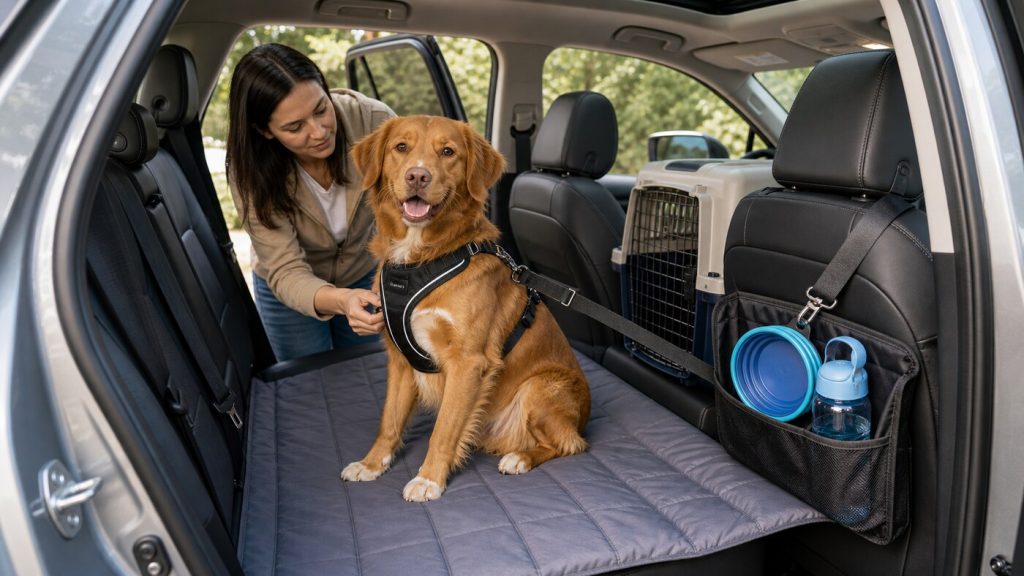
The American Veterinary Medical Association warns that pets should be properly restrained in vehicles, using an appropriate safety harness, crate, or carrier. The point is not only pet comfort. Unrestrained pets can be injured and can also distract the driver.
That single point changes how buyers should think about the category. A travel product is not just evaluated by color, pocket count, and low MOQ. It should be evaluated by structure, fit, restraint points, ventilation, escape resistance, cleaning, instructions, and whether the product’s marketing language stays realistic.
Travel also introduces documentation and destination rules. USDA APHIS maintains pet travel information for U.S. import, export, and interstate movement, and international trips can involve country-specific requirements. That does not mean a carrier manufacturer becomes a veterinary documentation provider. It does mean travel-product brands should avoid vague “approved everywhere” language and should help consumers check the actual carrier, airline, and destination rules.
The category is a system, not one SKU
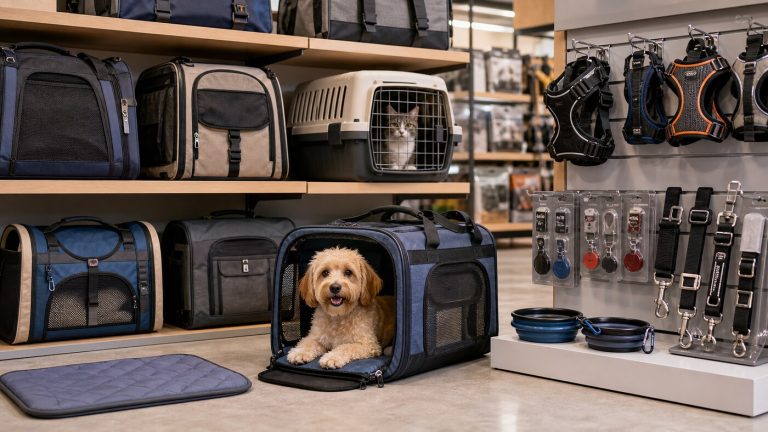
Pet travel gear covers several product lanes, and each lane has a different buyer logic.
Soft-sided carriers are often used for small dogs and cats in urban travel and cabin-style use. They compete on size, structure, ventilation, shoulder comfort, zipper strength, washable liners, collapse behavior, and whether the pet can turn or rest comfortably. The product may look simple, but returns can rise quickly if dimensions are vague or if the carrier sags after a few uses.
Hard crates and kennels are more structural. They compete on shell strength, door latch reliability, ventilation, assembly hardware, cleaning, stackability, and package protection. For buyers, the plastic grade, door alignment, screw quality, and stress points matter more than a product photo.
Car restraints include harnesses, seat belt tethers, barrier systems, crate tie-downs, and seat covers with restraint features. This is a sensitive lane because consumers may assume more safety than the product can prove. A buyer should distinguish between a walking harness, a car-compatible harness, and a restraint product with specific testing evidence.
Travel accessories include bowls, bottle systems, liners, ID tags, waste bags, feeding containers, calming mats, and compact first-aid or grooming add-ons. These can improve basket value, but they should be grouped around real use occasions, not just added as low-cost filler.
The strongest assortment does not need to be wide. It needs to be coherent: city carrier, car safety, crate travel, hydration, cleaning, and identification.
Vehicle products need especially careful claims
Car travel is one of the most important use cases because it is frequent and visible. Many pets ride in cars far more often than they fly.
The AVMA guidance that pets should be properly restrained supports the basic category logic. But buyers should be careful not to let that turn into overclaiming. A generic tether should not be marketed like a crash-tested restraint unless the supplier has credible evidence. A seat cover with a clip should not imply full crash protection. A carrier that works for short errands should not be presented as a universal vehicle safety system.
For B2B buyers, the practical question is: what exactly is the product designed to do? Is it meant to prevent distraction? Keep the pet in one area? Reduce movement during normal driving? Attach to a specific harness? Secure a crate? Protect upholstery? Each of these is a different claim environment.
This is similar to the point we made in our article on EU GPSR and pet product compliance. Safety information, traceability, warnings, and instructions are part of the commercial product. In travel gear, they are not optional fine print; they shape whether the user understands the limits of the item.
Airline-style carriers are not just about dimensions
Many soft carriers are sold with airline-oriented language, but buyers should treat this carefully. Airline policies differ, aircraft layouts differ, and rules can change. The safer approach is to provide accurate product dimensions, structure, ventilation, weight, material, and measurement instructions, while telling consumers to check the carrier and airline before travel.
IATA’s pet travel guidance emphasizes preparation, identification, and proper travel arrangements. For cargo and live animal transport, the broader regulatory environment is much more formal than ordinary retail packaging suggests. Even when a consumer product is intended for cabin-style use rather than cargo, the buyer should respect the seriousness of the use case.
The product details matter. Does the carrier hold its shape when carried by the handle? Does the base bend? Are mesh panels strong enough to resist scratching? Is there enough ventilation across multiple sides? Does the zipper open smoothly but resist pet escape? Is the liner removable and washable? Is the shoulder strap comfortable when the carrier is loaded?
For cats, stress and escape resistance are especially important. For small dogs, comfort, weight distribution, and owner carrying ergonomics become major review drivers. For both, unclear sizing creates returns and poor reviews.
Supplier evaluation should include stress points
Pet travel gear should be inspected around failure points, not just appearance.
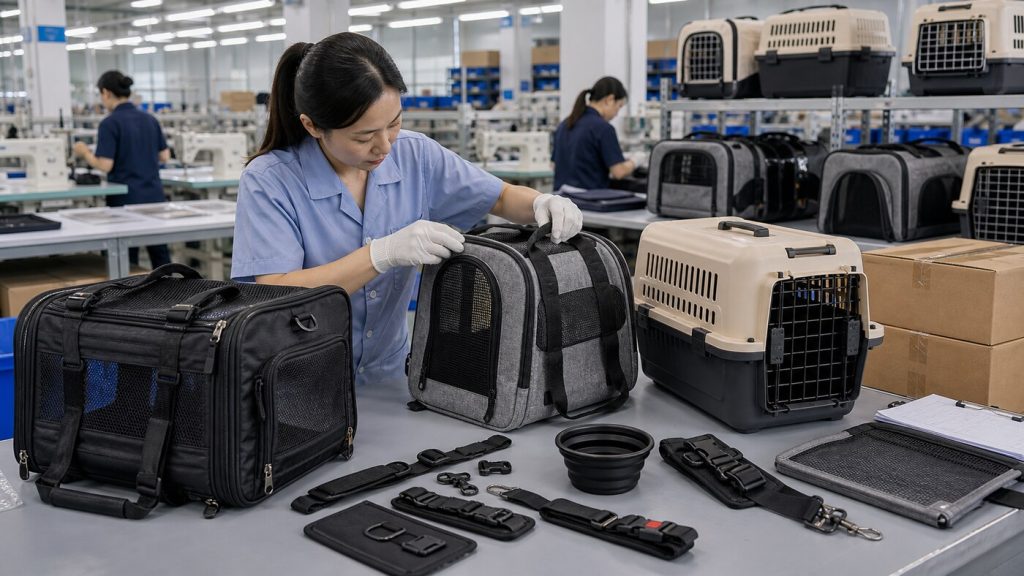
For soft carriers, buyers should test zipper strength, seam reinforcement, handle attachment, strap anchors, mesh tear resistance, base rigidity, liner fit, odor, and cleaning behavior. A carrier can look premium in a sample photo and fail at the handle or zipper after a few trips.
For hard crates, buyers should check plastic thickness, hinge and latch alignment, door fit, ventilation holes, assembly hardware, sharp edges, and carton protection. Dimensional consistency matters because crate parts often rely on alignment.
For car tethers and harnesses, buyers should review webbing thickness, stitching pattern, buckle quality, attachment hardware, adjustability, edge softness, and compatibility instructions. If the product is not tested for crash performance, packaging should not imply it is.
For bowls and travel bottles, leakage and cleaning are the repeat-use tests. If the bottle leaks in a car bag or a silicone bowl keeps odor, the product may sell once but not build category trust.
Packaging has to reduce misuse
Travel products are often used under pressure. A consumer may be packing quickly, entering a vehicle, arriving at a hotel, or preparing for a flight. Packaging and instructions should reduce ambiguity.
Useful packaging explains measurement, weight limits, use position, cleaning, ventilation, warning language, and compatibility. A car tether should specify what it connects to and what it does not do. A soft carrier should explain internal dimensions and pet fit. A crate should include assembly checks and latch confirmation. A travel bottle should show cleaning and leak prevention.
Overly aggressive marketing can create problems. “Airline approved” is risky if the product is not tied to specific, current carrier requirements. “Crash safe” is risky without evidence. “Escape proof” is risky if the closure relies on user behavior. “Universal fit” is risky for harnesses and crates.
Travel gear therefore benefits from sober language. The best products do not need exaggerated claims; they need clear specifications.
Channel strategy depends on the trip type
Travel gear performs differently by channel.
Pet specialty retailers can build displays around road trips, city mobility, puppy and kitten transport, and vacation planning. Ecommerce works well for products that need detailed size charts, videos, user reviews, and comparison tables. Veterinary clinics and groomers may support starter carriers, recovery transport, or cat-friendly travel products, but the assortment should stay practical and credible.
Bundles can work when they follow a real routine. A car travel kit might combine a harness, tether, seat cover, portable bowl, and waste-bag holder. A cat carrier kit might include a structured carrier, washable liner, ID tag, and calming travel mat. A road-trip assortment might connect carriers with hydration products, which we analyzed in our article on pet cooling and hydration products.
The category also connects with outdoor gear. Our article on dog camping beds and outdoor pet gear discussed occasion-driven pet products. Travel gear follows the same logic: the product must match the use case, not just the pet species.
Buyer questions before scaling the line
Before placing a large order, buyers should ask a few practical questions.
What trip type is the product for: daily car rides, city transit, vet visits, hotel stays, airline cabin-style use, cargo-style transport, or outdoor travel? What pet size and temperament does it realistically serve? What failure points were tested? What claims are supported by evidence? What instructions reduce misuse? What packaging protects the product in transit? What return reasons are likely?
Buyers should also ask whether the supplier understands market language. A factory may be strong at sewing, plastic molding, or hardware sourcing but weak at claims discipline. That gap matters because travel products can be misunderstood by consumers.
The best sourcing process treats pet travel gear as an engineered category with lifestyle appeal, not a lifestyle category with a few engineered parts.
Our view
Pet travel products are becoming more important because pets are traveling in more ways: short car rides, city mobility, vet visits, weekend trips, hotels, and longer-distance movement. That growth creates opportunity, but it also raises expectations.
For global buyers and distributors, the strongest travel assortments will combine clear use cases, durable construction, conservative safety language, and good instructions. The weakest assortments will rely on broad claims, vague dimensions, and low-cost accessories that look similar online but fail in real use.
Our view is that pet travel gear should be managed like a safety-adjacent category. It can still be attractive, colorful, and retail-friendly. But the commercial foundation is trust: the carrier holds shape, the zipper survives, the harness fits, the crate latches, the bowl does not leak, and the packaging tells the owner what the product can and cannot do.
References
AVMA guidance on pets in vehicles